15 Turquoise Hair Color Styles: The Complete Guide to Pulling Off This Bold Color
Ever catch yourself staring at someone’s turquoise hair in a coffee shop, thinking — how do they make that look so good? I’ve had that exact thought more times than I can count. Turquoise hair is one of the most vivid, eye-catching, and genuinely fun color choices you can make — and this guide covers everything you need to know before, during, and after you take the plunge.
So, what is turquoise hair? Turquoise hair refers to hair dyed in shades that fall between blue and green — typically ranging from deep teal to bright aqua to electric blue-green. Achieving it on dark hair requires bleaching first. The color is semi-permanent and fades within 4–8 weeks without proper maintenance.
Keep reading — I’ll walk you through 15 specific turquoise hair styles, explain the bleaching process honestly, which skin tones turquoise flatters most, the dye brands colorists actually recommend, and the exact maintenance routine that keeps this color from turning swamp-green too fast.
What You Need to Know Before Going Turquoise
Let me be upfront about something most articles skip entirely. Turquoise is a fantasy color — and fantasy colors require pre-lightened hair to show up properly. On dark hair, turquoise applied without bleaching will show up as a subtle tint at best and be invisible at worst. The lighter your starting point, the brighter and truer your turquoise result.
That said, you don’t necessarily need to bleach to platinum. Turquoise applied over a pale yellow or light blonde base produces the truest aqua. Applied over dark blonde or light brown, it reads as a deep teal. Applied over medium brown (without bleaching), it adds a subtle blue-green shimmer in sunlight. Knowing your starting point sets your expectations correctly — which is the most useful thing I can tell you right now.
Turquoise also fades. It’s not a question of “if” but “how fast.” On porous or bleached hair, expect 4–6 weeks before significant fading. On healthier, less porous hair with the right maintenance, you can stretch that to 8 weeks or more. I’ll show you exactly how.
15 Turquoise Hair Styles: Full Breakdown
1. Full Turquoise All-Over Color
The most committed, most dramatic, most unmissable version of turquoise hair. Every strand, root to tip, is dyed in a solid turquoise shade. On bleached platinum or pale blonde hair, the result is electric — a vivid, saturated aqua that catches every light source in the room. This is the style for women who don’t want any ambiguity about their hair choice. It’s loud, it’s intentional, and it’s genuinely stunning when maintained properly. Practical tip: Full turquoise all-over color requires the most upkeep. Expect to refresh the color every 4–6 weeks and use color-depositing conditioner twice weekly to keep the saturation from fading to a muted teal-grey.
2. Turquoise Ombre (Dark to Turquoise)
The turquoise ombre keeps the roots and upper lengths in the natural or dark color while transitioning to turquoise through the mid-lengths and ends. This is the most wearable and grow-out-friendly version of turquoise hair — when the color fades or you want a change, you simply trim the colored ends. The contrast between dark roots and bright turquoise ends is visually striking without requiring bleaching the entire head. On dark brown or black bases, the ombre transition typically passes through a teal stage before reaching true turquoise at the ends, which creates a beautiful multi-tonal gradient.
3. Turquoise Balayage
Turquoise balayage uses the freehand painting technique to apply turquoise in natural, sun-kissed-looking sections throughout the hair rather than as a solid color. The result is playful, dimensional, and less aggressive than full all-over turquoise. Selected sections are lightened and dyed while the rest of the hair stays in the natural base color. The turquoise pieces frame the face and catch light as the hair moves. This is one of the best introductory turquoise styles for women who want color without full commitment — and it grows out far more gracefully than solid color.
4. Turquoise and Dark Blue Hair (Ocean Blend)
Mixing turquoise with deep navy or cobalt blue creates a multidimensional ocean-inspired effect — multiple shades of blue-green living in the same head of hair. The effect mimics the way sunlight hits deep water: dark in the depths, bright teal near the surface. This blended approach also helps turquoise last longer visually, because even as the bright turquoise fades, the deeper blue sections remain and keep the overall look intentional. Ocean blends work especially well on women with longer hair where the different tones have room to separate and flow.
5. Turquoise and Green Hair (Mermaid Blend)
Taking the palette in a greener direction, turquoise and forest or emerald green blended together create the ultimate mermaid hair. Where ocean blend leans blue, mermaid blend leans green — and the turquoise acts as the bridge between the two. This combination is endlessly flattering in natural light. Because green holds slightly better than pure turquoise, this blend also tends to age more gracefully as it fades, transitioning through beautiful soft teal stages. Best for: Women with olive or medium skin tones where the green elements add warmth rather than clash.
6. Turquoise Highlights on Dark Hair
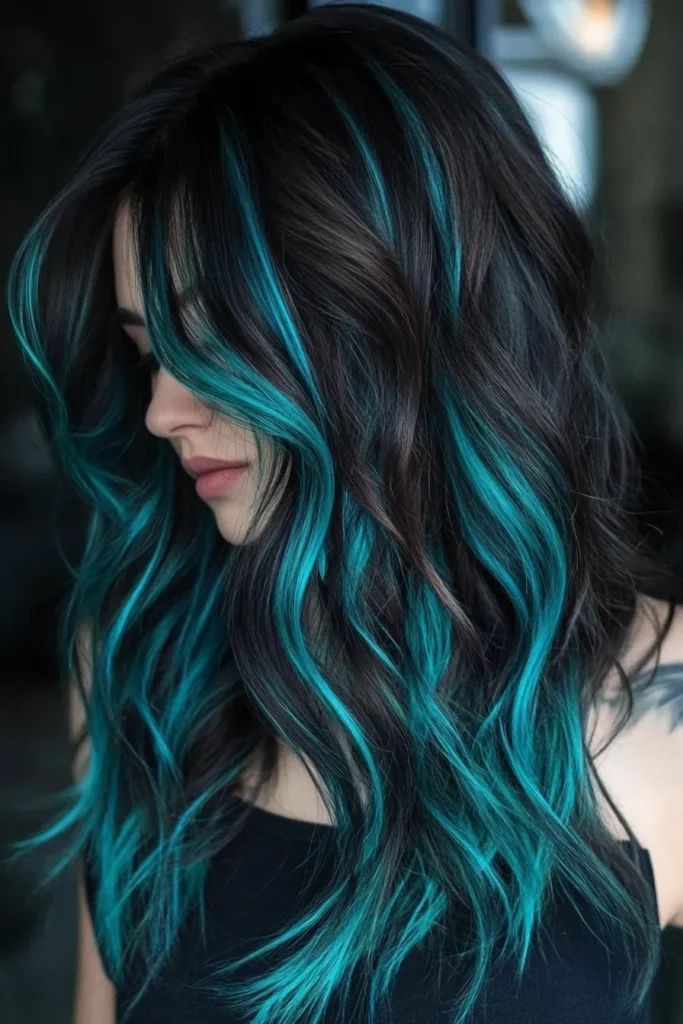
For women who aren’t ready to bleach their whole head, turquoise highlights — applied to individual sections over a bleached underlayer — bring pops of color without full commitment. The dark base makes the turquoise highlights pop dramatically. This approach requires selective bleaching on just the highlighted sections rather than the entire head, reducing overall damage significantly. The highlights can be placed throughout for a scattered, dimensional look or concentrated at the face frame for maximum impact with minimum coverage.
7. Turquoise Peekaboo Hair
Peek-a-boo turquoise is placed in the underlayer of the hair — underneath the top layer — so it’s only visible when the hair moves, is pulled up, or parts naturally. From the front, the hair appears its natural color. From behind, in a ponytail, or when the wind catches it — flashes of vivid turquoise appear. This is the most discreet version of turquoise hair imaginable. It’s perfect for women navigating workplace appearance policies or family situations while still satisfying the urge for bold color. The color can also be a beautiful surprise when discovered.
8. Turquoise Hair with Silver or White Accents
Combining turquoise with icy silver or white sections creates a futuristic, otherworldly aesthetic that’s genuinely unlike anything else in the current hair color landscape. The silver acts as a cool neutral between turquoise sections, allowing each color to breathe and intensify the perception of the other. Both colors require heavily bleached hair to achieve, so this is a high-commitment, high-reward option. The result photographs magnificently and works particularly well on women with cool or neutral skin undertones where the icy tones in the silver complement naturally.
9. Pastel Turquoise Hair
Pastel turquoise — diluted with white or conditioner to create a soft, washed-out aqua — is the gentler, dreamier sibling of vivid turquoise. Where saturated turquoise is electric and bold, pastel turquoise is ethereal and soft. It sits closer to an aquamarine or sea foam green and works beautifully on women who want fantasy color without intensity. Important: Pastel colors require the whitest, most platinum blonde base possible to show up true — on hair with any remaining yellow tones, pastel turquoise will pull green rather than the intended sky-blue-green.
10. Turquoise Hair with Black Roots (Grunge Aesthetic)

Source: @Instagram
Letting dark roots grow or intentionally dyeing roots dark while keeping vivid turquoise through the mid-lengths and ends creates a grunge-inspired, effortlessly cool aesthetic. The dark-light contrast is deliberate rather than grown-out-looking. This style is currently very popular in alternative fashion circles and works brilliantly for women who want turquoise hair but don’t want to maintain perfectly touched-up roots. The dark roots actually extend the life of the overall look by making the color appear intentional at every stage of grow-out.
11. Turquoise Bob

Source: @Instagram
Short hair and turquoise are an incredibly powerful combination. On a bob — whether blunt, textured, or asymmetrical — turquoise becomes almost sculptural. The shorter the hair, the more saturated and graphic the color reads. A blunt turquoise bob in particular creates a very editorial, high-fashion look that sits at the intersection of bold color and precise cutting. Because there’s less hair to dye and maintain, the bob is also the most economical way to experience full turquoise color.
12. Turquoise Pixie Cut
The turquoise pixie is the most adventurous combination on this list. Very short hair dyed vivid turquoise puts the color — and the person wearing it — front and center with absolutely no softening length to hide behind. This combination signals maximum confidence and style commitment. It also has a practical benefit: color refresh appointments are faster and cheaper on a pixie than any other length, making the high maintenance of vivid color more manageable. The pixie also allows the color to fade beautifully into a softer, pastel version without looking unkempt.
13. Turquoise Hair for Dark Skin Tones
This style gets its own entry because the conversation around which skin tones suit turquoise is woefully incomplete in most articles. The answer is simple: deep, rich turquoise — leaning toward teal or electric aqua — is genuinely stunning on deep and dark brown skin tones. The contrast between the vivid cool-toned color and the warmth of deep skin creates a striking visual that lighter skin tones simply can’t replicate in the same way. Avoid pastels on very deep skin tones (they tend to appear washed out against rich skin) and lean instead into saturated, deep turquoise or teal for maximum impact.
14. Turquoise Hair for Fair Skin Tones
On fair skin, turquoise hair creates a cool, almost ethereal contrast — the paleness of the skin and the vibrancy of the color create a strikingly graphic look. Fair skin suits both saturated and pastel turquoise — the lighter versions create a soft, fairy-like aesthetic, while vivid turquoise reads bold and fashion-forward. Women with pink or cool undertones in fair skin should lean toward blue-turquoise rather than green-turquoise, which can make cool-undertone skin appear slightly sallow.
15. Turquoise Hair with Curtain Bangs or Face-Framing Pieces
Concentrating turquoise specifically in the bangs — curtain bangs or full fringe — or in the face-framing sections creates maximum visual impact with minimum hair commitment. The color is closest to the face, where it immediately draws attention and interacts with eye color and skin tone in a way that’s uniquely flattering. Turquoise in particular tends to intensify the appearance of green, hazel, and blue eyes dramatically. Face-framing placement also means the color is easy to trim off if you decide to return to your natural color — no full grow-out required.
Comparison Table: 15 Turquoise Hair Styles
Which Style Matches Your Commitment Level and Hair Type?
| Style | Bleach Required | Commitment Level | Fade Rate | Best Skin Tone | Maintenance |
|---|---|---|---|---|---|
| Full All-Over Color | Yes (full head) | Very High | Fast (4–6 wks) | All tones | Every 4–6 weeks |
| Turquoise Ombre | Yes (ends only) | Medium | Moderate (6–8 wks) | All tones | Every 8–12 weeks |
| Turquoise Balayage | Yes (sections) | Medium | Moderate (6–8 wks) | All tones | Every 10–12 weeks |
| Ocean Blend (Blue Mix) | Yes (full head) | High | Slower (6–8 wks) | Cool/Neutral | Every 6–8 weeks |
| Mermaid Blend (Green Mix) | Yes (full head) | High | Slower (6–8 wks) | Olive/Warm | Every 6–8 weeks |
| Turquoise Highlights | Yes (sections) | Low-Medium | Moderate | All tones | Every 10–12 weeks |
| Peek-a-Boo | Yes (underlayer) | Low | Moderate | All tones | Every 12–16 weeks |
| Silver + Turquoise | Yes (full, platinum) | Very High | Fast (4–6 wks) | Cool/Neutral | Every 4–6 weeks |
| Pastel Turquoise | Yes (platinum needed) | High | Very Fast (3–4 wks) | Fair/Medium | Every 3–4 weeks |
| Black Roots + Turquoise | Yes (lengths only) | Medium | Graceful | All tones | Every 8–10 weeks |
| Turquoise Bob | Yes (full) | Medium-High | Fast | All tones | Every 4–6 weeks |
| Turquoise Pixie | Yes (full) | High | Fast | All tones | Every 4–6 weeks |
| For Dark Skin Tones | Yes (full) | High | Fast | Deep/Rich | Every 4–6 weeks |
| For Fair Skin Tones | Yes (full/partial) | Medium-High | Fast-Moderate | Fair/Pale | Every 4–8 weeks |
| Face-Framing/Bangs | Yes (sections) | Low | Moderate | All tones | Every 8–10 weeks |
Common Mistakes and How to Avoid Them
1. Not Bleaching Light Enough Before Applying Color This is the single biggest reason turquoise results disappoint. On hair with yellow or orange tones remaining after bleaching, turquoise will pull green, muddy, or dark rather than the vivid aqua you wanted. Aim for a pale yellow (level 9 or 10) before applying vivid turquoise for the truest result. If your hair isn’t light enough, wait and do a second bleach session — don’t rush.
2. Applying Turquoise to Wet Hair Without Understanding Dilution Turquoise dye applied to soaking wet hair will appear lighter and more diluted once dry than expected. For vivid, saturated results, apply dye to towel-dried (damp, not wet) hair. For pastel turquoise, deliberately diluting with white conditioner on dry or damp hair gives more predictable results.
3. Skipping the Sulfate-Free Shampoo Switch Sulfate shampoos are one of the fastest ways to strip vivid color. After any fantasy color, you must switch to a sulfate-free formula immediately. Regular shampoo used on vivid turquoise hair will fade the color to a washed-out teal within 2–3 weeks. It’s the single most impactful product switch you can make.
4. Washing Too Frequently Vivid colors like turquoise are semi-permanent and water-soluble — every wash removes a layer of pigment. Stretch washes to every 3–4 days, use dry shampoo between wash days, and always rinse with cool water (hot water opens the cuticle and accelerates color loss dramatically).
5. Ignoring Color Bleeding on Clothing and Pillowcases Fresh turquoise dye bleeds. Badly. Wear a dark shirt for the first few washes, sleep on a dark pillowcase, and use a dark towel. The bleeding stops after 2–3 washes but will stain everything light-colored it touches until then. This is genuinely one of the most practically important things to warn people about and most articles skip it entirely.
6. Using the Wrong Products During Toning After bleaching to pale yellow, many people skip toning before applying turquoise. But turquoise on a slightly warm (yellow) base will always pull slightly green. Applying a light violet or neutral toner after bleaching before the turquoise creates a clean, cool-toned canvas that produces a truer aqua result.
Similar Variations Worth Exploring
- Teal Hair — Darker and more blue-green than turquoise; less bright but deeper and longer-lasting
- Aqua Hair — Lighter and more blue-leaning than turquoise; very close to electric sky blue at its lightest
- Peacock Hair — Multi-tonal blend of teal, turquoise, cobalt, and emerald; complex and dimensional
- Mint Hair — Very pale, desaturated green-blue; gentler than pastel turquoise and requires less vivid pigment
- Electric Blue Hair — The blue sibling of turquoise; cooler and more purple-adjacent; holds slightly longer than turquoise
Hair Care Tips for Turquoise Hair
Before Color Application
- Bleach your hair in the healthiest possible condition — condition aggressively for 2–3 weeks before your lightening appointment
- Use a bond-building treatment (Olaplex No.1 or similar) mixed into the bleach to minimize structural damage during lightening
- Do NOT use protein-heavy treatments in the 48 hours before bleaching — they can cause uneven color uptake
- Tone to a cool, neutral blonde before applying turquoise for the truest color result
During the Wear Period
- Wash every 3–4 days using cool water only — never hot
- Sulfate-free shampoo from day one — no exceptions
- Apply a blue-green color-depositing conditioner once per week to refresh pigment between full dye sessions
- Use a leave-in conditioner on the mid-lengths and ends after every wash — bleached hair needs constant moisture
- Sleep on a satin pillowcase to reduce friction and color transfer
- Use a UV-protectant hair product if spending time outdoors — UV rays break down vivid pigments significantly faster than indoor exposure
When the Color Starts to Fade
- Faded turquoise often pulls toward a soft teal or sea-foam green — this can be beautiful on its own or refreshed back to vivid turquoise with a color refresh session
- At-home color refresh: mix turquoise dye with white conditioner (1:3 ratio) and apply as a conditioning treatment for 20–30 minutes — this refreshes without full re-dying
- Deep condition before any re-dye to restore moisture to porous, bleached hair
Recommended Product Types
- Shampoo: Sulfate-free, color-safe (look for “vivid color” formulas)
- Conditioner: Color-depositing in blue-green or teal shade
- Weekly treatment: Deep conditioning mask with argan oil, shea, or panthenol
- Leave-in: Lightweight spray leave-in for daily moisture
- Styling: Heat protectant before any hot tool — non-negotiable on bleached hair
Outro
Turquoise hair is bold, beautiful, and genuinely one of the most joyful color choices in the entire hair spectrum. Whether you go all-in with full saturated aqua, play it subtle with peek-a-boo highlights, or blend it with blue and green in an ocean mermaid wave — this color rewards women who commit to taking care of it.
The honest truth is that turquoise hair is work. It fades. It bleeds. It needs sulfate-free products and cool water and deep conditioning and color deposits. But the payoff — walking into a room with hair that glows like sea glass in the sun — is absolutely worth every bit of it. Now go make your turquoise hair dreams happen.