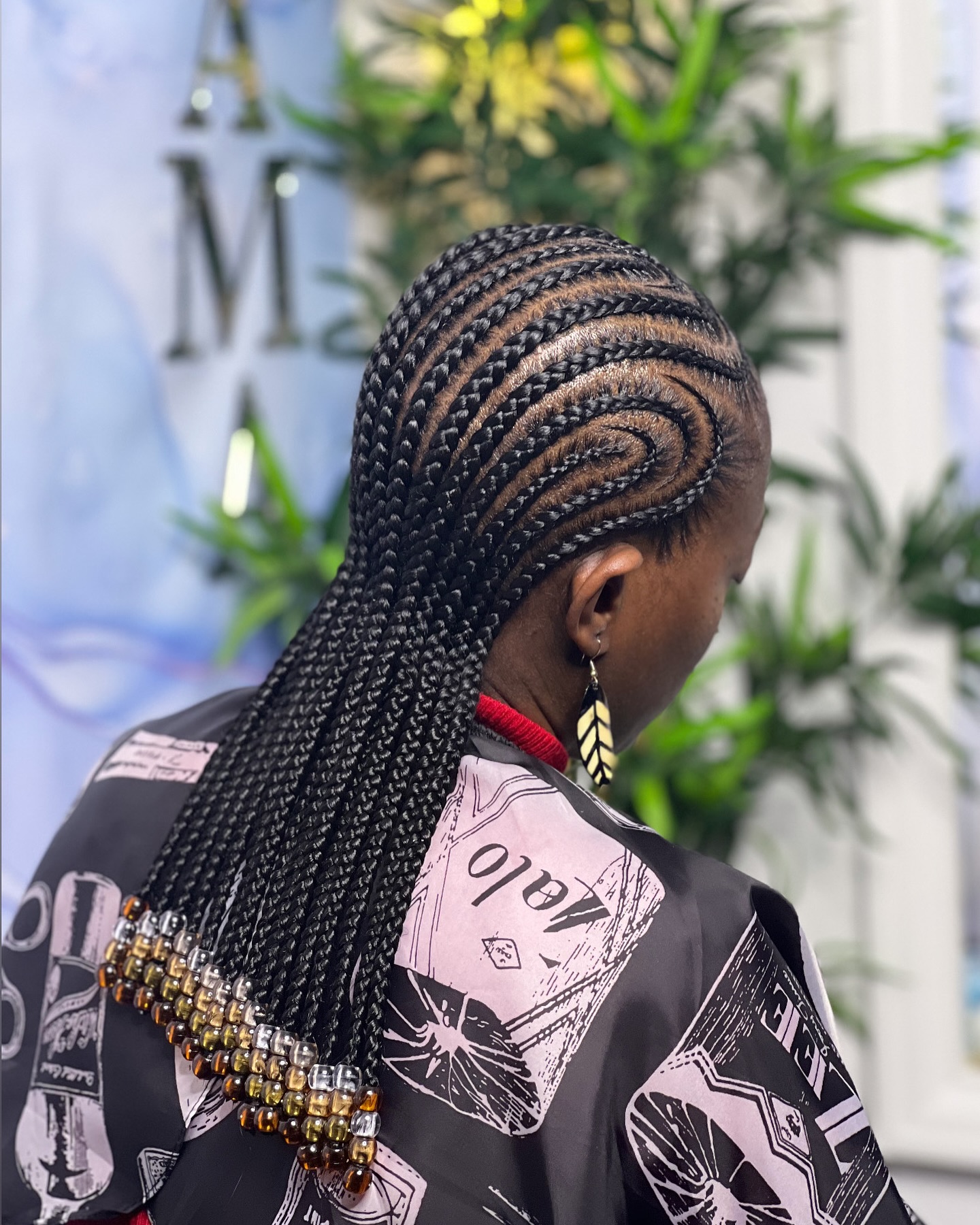
17 Stitch Braids With Design That Prove Your Hair Is a Work of Art
Ever scroll through Instagram and stop dead at a set of braids so precise, so beautifully patterned, you genuinely couldn’t tell whether it was hair or a piece of carefully crafted textile? That’s the power of stitch braids with design — and once you understand how they work, you’ll never look at plain braids the same way again. I’ve worked closely with some incredibly skilled braid artists, and I’m here to break down everything: the designs, the techniques, the tools, and the maintenance secrets most tutorials completely skip over.
I’ve tested, worn, and analyzed dozens of stitch braid variations — so everything I share here is grounded in real experience, not just recycled tips.
So what are stitch braids with design? Stitch braids with design are feed-in cornrow braids created using the stitch braid technique, where the hair is parted in small, evenly spaced horizontal “stitches” or lines perpendicular to the braid direction before each feed-in addition. This creates a precise, ladder-like pattern along the braid that can be enhanced with shaved or carved designs in the scalp between the braid rows. The result is a clean, geometric look that combines braiding artistry with barbering-style line work.
Keep reading — because I’m about to show you 17 stunning stitch braid designs, explain exactly how each one is constructed, walk you through the best designs for your face shape and hair type, and share a complete care guide so your style stays fresh for weeks.
What Makes Stitch Braids Different From Regular Braids?
Before we get into the 17 designs — let’s clear something up. A lot of people confuse stitch braids with regular feed-in cornrows. Here’s the actual difference:
Regular Feed-In Cornrows:
- Hair is added in sections from the sides into the growing braid
- The parting runs in a consistent forward or curved direction
- The braid lies relatively flat against the scalp
Stitch Braids:
- Hair is parted in small horizontal stitches (lines perpendicular to the braid direction) before each addition
- These stitches are visible as even, rhythmic lines running across the braid
- The effect looks like a perfectly laced seam or ladder running along each row
- The gaps between braid rows are where carve designs, shaved patterns, or graphic shapes can be added
That “stitched” appearance is what makes these braids look so architectural and deliberate. The design element is the cherry on top. Now — here are 17 ways to do it.
1. Classic Straight-Back Stitch Braids with Clean-Line Design

Source: @Instagram
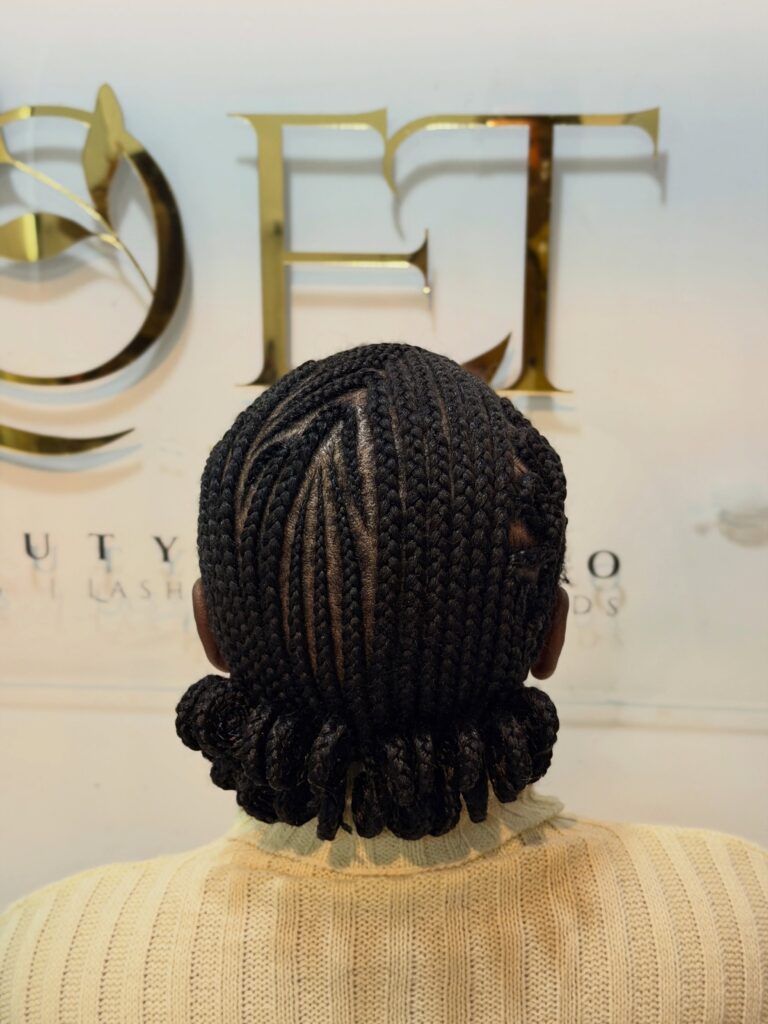
Start with the foundation. Straight-back stitch braids — running uniformly from the forehead to the nape — are the purest expression of this technique. Every stitch is visible in clean horizontal intervals along each braid row, creating a beautifully uniform texture. Between the braid rows, a skilled barber can shave razor-thin straight lines that run parallel to the stitches, amplifying the geometric quality of the style.
This is the best starting point if you’re new to stitch braids. It’s clean, universally flattering, and provides a solid template that any barber or braider with stitch braid experience can execute confidently.
Practical tip: Request that your braider space the stitches evenly at 1/4-inch intervals for the most consistent visual result. Uneven stitching disrupts the pattern and reduces the architectural quality of the finished style.
Best for: Men, teenage boys, anyone wanting a clean everyday protective style Face shape: All face shapes
Straight-back is the starting point — but if you want movement and dimension, curved styles are where things get really interesting.
2. Curved Stitch Braids with Swirl Design

Souce: @Instagram
Curved stitch braids sweep backward in a gentle S-curve from the front hairline rather than running in perfectly straight lines. This curve creates a dynamic, flowing quality that flatters round and square face shapes by drawing the eye upward and elongating the face.
The design element here comes from shaving a swirl or spiral pattern into the scalp at the crown, where the curved braids naturally converge. Done with a straight razor and a steady hand, this swirl design turns the braided crown into the visual focal point of the entire style.
Tip: The sharper the curve, the more precision your braider needs. Request a consultation before the appointment to sketch out the exact curve pattern so both you and your braider are aligned.
Best for: Round, square, and oval face shapes Design complexity: Medium
3. Zig zag-Part Stitch Braids

Source: @Instagram
The parting itself becomes the design in this variation. Instead of straight lines separating each braid row, the parts are cut in a sharp zigzag pattern — so the negative space between braids forms a continuous lightning bolt or chevron shape running from front to back.
Combined with the stitch braid technique along each braid row, the zigzag part adds a second layer of visual geometry. This style requires a skilled braider with a steady hand and ideally a rat-tail comb with a fine tip for clean zigzag lines.
Practical note: Zigzag parts are more fragile than straight parts — they can blur faster as new growth comes in. Expect to refresh the parts at the 3-week mark to maintain the sharpness.
Best for: Men and boys who want bold geometric drama Face shape: Long, oval
4. Stitch Braids with Spider Web Shaved Design

Source: @Instagram
This is where stitch braids fully merge with barbering artistry. A spider web design — concentric curved lines radiating from a central point, connected by spoke-like lines — is shaved into the scalp at the temple or side of the head. The stitch braids run above and below the shaved web, framing it like a canvas.
The spider web is a fairly advanced shaved design, requiring a skilled barber with liner or T-outliner clippers. The result is genuinely jaw-dropping — especially when the rest of the stitch braids are kept clean and uniform to let the web design do the heavy lifting visually.
Best for: Creative styling, events, personal expression Maintenance: The shaved design needs touch-up every 2 weeks as hair grows back
5. Stitch Braids with Fade on the Sides
One of the most popular combinations right now: stitch braids on top of the head paired with a clean fade on the sides and back. The fade tapers from skin at the bottom up to the natural hair at the braid line, creating a crisp, modern contrast between the textured braids above and the clean-shaved sides below.
You can add a shaved line (a hard part) along the sides to make the boundary between fade and braid even more defined. This combination is versatile enough for professional environments while still being undeniably sharp.
Tip: Get your fade touched up every 10–14 days. Even though the braids can last 4–6 weeks, the fade grows out in 2 weeks and a blurry fade kills the sharpness of the whole look.
Best for: Men, teenage boys, students, professionals Face shape: All face shapes
6. Triangle-Parted Stitch Braids
Instead of rectangular box sections between each braid row, triangle-parted stitch braids use triangular sections as the base. This means the parts where each braid starts form a row of alternating triangles rather than straight lines — adding subtle geometric interest even before the stitch effect or designs are factored in.
Triangle parts also distribute scalp tension more evenly than box parts, making this a slightly more comfortable option for those with sensitive scalps.
Design addition: Shave a row of small triangles or arrowheads into the scalp between the braid rows to echo the triangular parts throughout the style for full geometric cohesion.
Best for: Those wanting design without being too flashy Scalp comfort: High — triangle parts reduce tension
7. Stitch Braids with Crown Design
The crown of the head — the highest point — is the natural anchor for a standout design. In this style, the stitch braids flow backward from the front hairline and converge at a central point at the crown, where a bold shaved design is placed: a star, a compass rose, a sunburst, or a custom pattern.
The braids essentially frame the crown design, drawing the eye directly to it. This style photographs especially well from above (hello, aerial drone shots and top-angle selfies).
Tip: Discuss the crown design in detail before sitting down. Bring a reference image. Crown designs need to be symmetric to the braid flow, and adjustments mid-process are difficult.
Best for: Statement styles, creative expression, events Complexity: High
8. Stitch Braids with Geometric Scalp Art
This is full braid artistry. Geometric shapes — hexagons, diamonds, triangles, crosshatch lines — are shaved into the visible scalp between the braid rows. The stitches in the braids themselves create horizontal lines, and the shaved geometry between the rows creates vertical and diagonal shapes, building a complete geometric grid across the head.
No two geometric stitch braid styles look exactly the same because the geometry is customized to the spacing of the braids and the shape of the head. This is one of the most technically demanding designs on this list.
Best for: High-end braid artistry appointments, special occasions, competitions Stylist requirement: Must have portfolio experience with scalp art designs
9. Stitch Braids with Colored Extensions
Color transforms stitch braids. Adding colored extensions — burgundy, honey blonde, ocean blue, auburn — into the stitch braid pattern does two things simultaneously: it adds visual depth to the braid texture and creates a natural ombre or highlight effect as the color runs through the stitches.
The horizontal stitch lines become even more visible when two colors contrast inside the same braid — imagine a black and caramel alternating stitch pattern. The color change inside each braid highlights the individual stitches and makes the pattern almost hypnotic.
Color tip: Use pre-stretched kanekalon in two contrasting but harmonious shades. Feed both colors alternately during each stitch addition for a natural blend rather than harsh stripes.
Best for: Anyone wanting color without chemical treatment Extension type: Pre-stretched synthetic braid hair
10. Stitch Braids with Heart Design

Source: @Instagram
Romantic, personal, and surprisingly bold — a heart-shaped shaved design placed at the temple or nape of the neck, framed by stitch braids, is one of the most requested custom braid designs for couples and Valentine’s Day styles. But honestly? It’s a year-round look when done with clean precision.
The heart can be outline-only (just the perimeter shaved) or fully shaved (entire interior of the heart is clean-cut). An outlined heart is more subtle; a fully shaved heart reads from across the room.
Best for: Personal expression, couples’ styles, events, birthdays Placement options: Temple, nape, behind the ear, crown
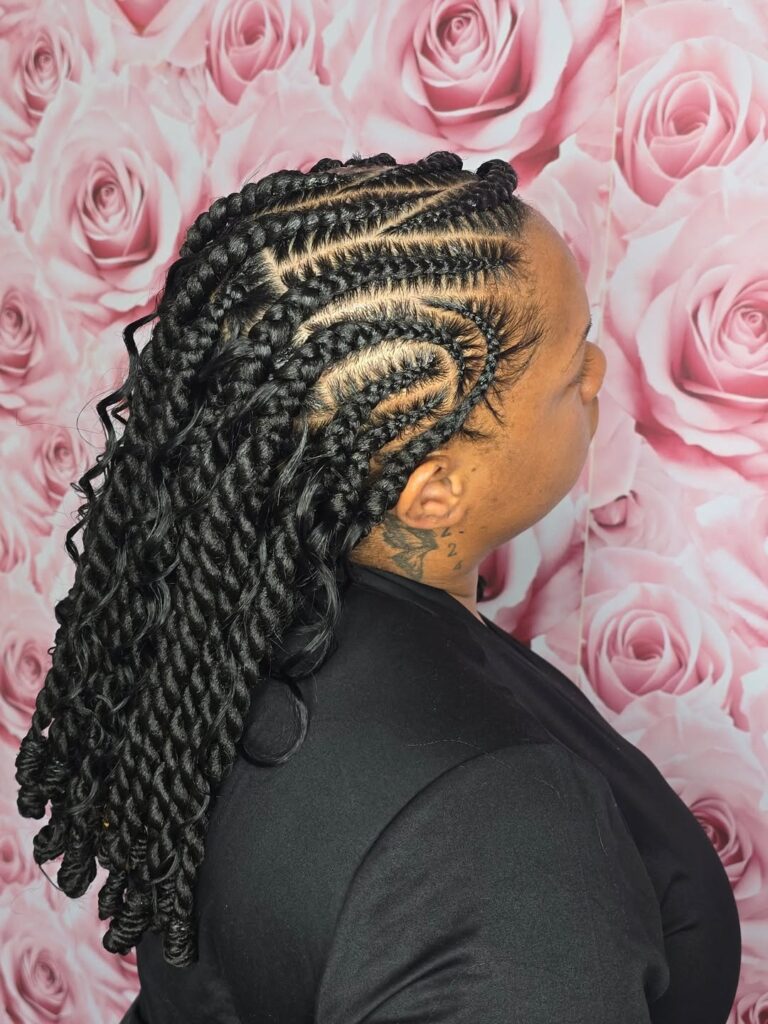
11. Stitch Braids with Tribal-Inspired Line Design
Source: @Instagram
Tribal-inspired designs pull from traditional African aesthetic lineage and combine it with the modern stitch braid technique. Think: bold, clean lines running perpendicular to the braids in rhythmic, evenly-spaced sets — like a series of parallel horizontal marks or a repeating dash-dot-dash pattern shaved between each row.
These designs have deep cultural significance and look extraordinary as scalp art. The key is restraint and precision — the lines must be straight, evenly spaced, and clean-cut for the tribal aesthetic to read correctly.
Cultural note: Tribal-inspired designs have rich roots in African hair tradition. Wearing them is a celebration of that heritage and artistry.
Best for: Those with cultural connection to the aesthetic, creative styling, events Complexity: Medium
12. Stitch Braids with Number or Letter Design
Want truly personalized stitch braids? Numbers or letters shaved into the scalp between braid rows — a jersey number, initials, a significant date — create a completely unique style that belongs to you alone.
Letters and numbers work best in simple, bold fonts (block letters, not cursive) when carved into hair. Thin serifs and ornate script require an extremely steady hand and get blurry as hair grows back. Keep it bold and simple for maximum impact and longest-lasting legibility.
Best for: Athletes, personal milestones, birthdays, team events Touch-up: Every 2 weeks to maintain letter/number legibility
13. Stitch Braids Mohawk Style
The stitch braid mohawk takes all the elements of a classic mohawk — shaved sides, raised center strip — and replaces the usual loose or teased center with a row of crisp stitch braids running from forehead to nape. The sides can be faded, shaved, or have additional designs cut into them.
This is a powerful style that’s become a staple in competitive hair shows and high-fashion editorial contexts. It fuses barbering (the shaved sides) and braiding artistry (the stitch center) into one cohesive look.
Best for: Bold personal expression, hair competitions, fashion events Commitment level: High — shaved sides require maintenance every 1–2 weeks
14. Stitch Braids with Floral Shaved Design
A floral design — roses, lotus flowers, sunflowers, simple petal forms — shaved into the scalp between braid rows adds softness and elegance to a style that can often feel very angular and geometric. The contrast between the rigid stitch pattern and the organic floral shapes creates visual tension that’s genuinely beautiful.
Floral designs are best placed at the temple or behind the ear for natural framing. They require an artist with a very steady liner and experience with curved shaved designs, as petals and curves are significantly harder to execute than straight lines.
Best for: Women and girls who want artistic scalp designs, special events Complexity: High
15. Stitch Braids with Diamond Grid Design

Source: @Instagram
A grid of diamonds — created by crossing two sets of shaved lines, one diagonal in each direction — runs between the braid rows in this design. The diamond grid is one of the most versatile shaved designs because its scale can be adjusted: small diamonds create a dense, jewel-like pattern; large diamonds create a bold, graphic statement.
Pair with uniform straight-back stitch braids for the cleanest presentation. The diamonds do all the creative work; keep the braids consistent.
Best for: Geometric aesthetics, modern styling, men and boys Complexity: Medium-High
16. Stitch Braids in a Halo Pattern
Instead of flowing backward from front to nape, halo stitch braids circle the head in a ring pattern — like a crown or laurel wreath. Each braid runs horizontally around the head rather than vertically from front to back, and the stitch lines run vertically, perpendicular to the braid direction.
This unusual orientation creates a completely different visual effect — one that’s circular and almost architectural when viewed from above. It’s a highly creative style that requires an experienced braider who has worked with halo or circular braid patterns before.
Best for: Creative editorial styling, unique events, hair shows Complexity: Very High
17. Stitch Braids with Dipped Color Ends
The final style keeps the scalp and braid pattern clean but adds a bold color statement at the tips. Stitch braids are installed with black or dark brown extensions, then the bottom 3–4 inches of each braid is dipped in a color — either using semi-permanent dye, colored hair paint, or pre-colored extension tips.
Popular dipped color choices for stitch braid ends include burgundy, blonde, cobalt blue, and deep red. The dipped effect is subtle when the braids hang naturally but creates a burst of color when the braids move.
Tip: Use pre-colored extension tips rather than dyeing after installation — it’s cleaner, faster, and more even. Ask your braider to incorporate the colored tips during the feed-in process.
Best for: Anyone who wants color drama without full color commitment Maintenance: Low — dipped ends don’t require retouching until the braids are taken down
Complete Stitch Braid Design Reference Tables
Style Selector Table
| Design Style | Complexity | Best For | Face Shape | Maintenance Frequency | Special Skill Needed |
|---|---|---|---|---|---|
| Classic Straight-Back | Low | Everyone | All | Every 4–6 weeks | No |
| Curved with Swirl Design | Medium | Round, Square | Round, Square | Every 3–4 weeks | Barber for design |
| Zigzag-Parted | Medium | Bold look | Long, Oval | Every 3 weeks | Precise parting |
| Spider Web Shaved Design | High | Statement styles | All | Every 2 weeks | Skilled barber |
| Braids + Fade | Low-Medium | Professional + stylish | All | Every 2 weeks (fade) | Barber for fade |
| Triangle-Parted | Medium | Comfort + style | All | Every 4–6 weeks | Precise parting |
| Crown Design | High | Events, standout | All | Every 2–3 weeks | Skilled barber |
| Geometric Scalp Art | Very High | Artistry, competition | All | Every 2 weeks | Scalp art barber |
| Colored Extensions | Low | Color lovers | All | Every 4–6 weeks | No |
| Heart Design | Medium | Personal expression | All | Every 2 weeks | Barber for design |
| Tribal Line Design | Medium | Cultural, creative | All | Every 2 weeks | Barber |
| Letter/Number Design | Medium | Athletes, personal | All | Every 2 weeks | Barber |
| Mohawk Style | High | Bold, fashion | Oval, Long | Every 1–2 weeks | Barber + braider |
| Floral Shaved Design | High | Elegant events | All | Every 2 weeks | Skilled barber |
| Diamond Grid | Medium-High | Geometric aesthetic | All | Every 2 weeks | Barber |
| Halo Pattern | Very High | Editorial, shows | All | Every 4–5 weeks | Expert braider |
| Dipped Color Ends | Low | Color, everyday | All | Every 4–6 weeks | No |
Stitch Braid Extension Guide
| Extension Type | Best Use Case | Hold Quality | Cost Per Pack | Typical Packs Needed |
|---|---|---|---|---|
| Pre-Stretched Kanekalon | All stitch braid styles | Excellent | $5–$12 | 3–5 packs |
| Regular Kanekalon | Budget option | Good | $3–$8 | 4–6 packs |
| Pre-Colored Extension Tips | Dipped end styles | Excellent | $8–$15 | 3–4 packs |
| Mixed Color Kanekalon | Color stitch braids | Good | $6–$12 | 3–5 packs |
| Human Hair Braid Extensions | Premium result | Excellent | $30–$80 | 3–4 packs |
Common Mistakes and How to Avoid Them
Stitch braids are a precision style. These mistakes come up again and again — and all of them are avoidable.
1. Uneven Stitch Spacing The entire visual appeal of stitch braids comes from the even, rhythmic spacing of the horizontal stitches. If the spacing is inconsistent — some stitches wide, some narrow — the pattern looks sloppy rather than architectural. Always use a fine-tooth rat-tail comb and take your time at each section.
2. Choosing a Barber Who Hasn’t Seen Your Reference Image “Stitch braids with a design” means different things to different people. Never describe a design verbally and assume it’s understood. Bring a reference photo and confirm your barber has executed that specific design before booking.
3. Braiding Too Tightly at the Hairline The hairline is the most fragile zone. Over-tight braiding at the temples and edges causes traction alopecia — a real, lasting form of hair loss. If you feel pain or see bumps along your hairline after braiding, the tension was too high. Always speak up immediately.
4. Neglecting the Shaved Design Touch-Up The stitch braid texture can last 4–6 weeks. The shaved design between the rows grows out and blurs in 10–14 days. If you let the shaved design grow back without touching it up, the whole style loses its impact. Budget for a barber visit every 2 weeks if your style includes a shaved design.
5. Washing Too Aggressively Rubbing or scrubbing shampoo into stitch braids disrupts the stitch pattern and causes frizz. Always use a diluted shampoo in a squeeze bottle, apply directly to the scalp in straight strokes following the braid direction, and rinse with low water pressure.
6. Skipping Scalp Moisturizing The exposed scalp between stitch braid rows is vulnerable to dryness — especially in the areas where designs are shaved. Apply a lightweight scalp oil (jojoba, tea tree blend, or braid spray) directly to the scalp every 3–4 days.
7. Keeping Stitch Braids In Too Long Stitch braids should come out at 6–8 weeks maximum. Beyond that, the new growth mats into the base of the braid, causing significant breakage on removal. Set a calendar reminder when you install the style.
Similar Variations Worth Exploring
Love stitch braids but want to explore the wider design braid space?
- Feed-In Cornrows: The foundation technique that stitch braids build upon — simpler but still very clean
- Invisible Braids: A feed-in technique where the braid start is completely hidden for an ultra-sleek appearance
- Lemonade Braids: Side-swept cornrows with the same feed-in technique — add stitch detail for extra precision
- Pop Smoke Braids: Diagonal stitch-style braids inspired by the late rapper’s signature look
- Scalp Braids with Carvings: Similar concept, focused more on the carved scalp art between non-stitch braids
- Knotless Box Braids with Designs: Individual rather than cornrow-style, but can incorporate scalp art designs in the parts
Hair Care Tips for Stitch Braids With Design
Protecting your natural hair during and after this style is just as important as the installation itself. Here’s what I recommend.
Moisturize the Scalp, Not the Braids The goal is scalp hydration, not braid saturation. Apply a light braid spray or diluted leave-in conditioner directly to the exposed scalp using an applicator nozzle bottle. Avoid soaking the braids themselves, which causes buildup and speeds up frizz.
Satin Bonnet Every Night Sleeping without protection causes braid frizz overnight and — more importantly — causes friction on the exposed scalp designs. A satin bonnet or satin pillowcase protects both the braids and the shaved design areas from overnight friction.
Wash Smartly, Not Frequently Limit washing to once a week maximum. Use a diluted sulfate-free shampoo in a squeeze bottle. Apply along the braid rows in straight lines — never in circular scrubbing motions — and rinse thoroughly. Follow with a light leave-in conditioner sprayed on the scalp.
Touch Up the Design on Schedule Book a barber appointment every 10–14 days to maintain any shaved designs between the rows. Even if the braids look fresh, a blurred design signals a neglected style.
Avoid Product Buildup Stitch braids expose a lot of scalp, and heavy creams or thick oils cause white residue buildup that’s very visible on dark skin. Use lightweight, clear oils (jojoba, argan, or a lightweight braid spray) rather than thick pomades or heavy butters.
Protect the Edges Apply a lightweight edge control along your hairline every morning. This keeps the front hairline sleek and extends the polished appearance of the stitch braid pattern all the way to the very front.
Conclusion
Stitch braids with design sit at the intersection of braiding technique and barbering artistry — and the results speak for themselves. From clean straight-back stitches to elaborate geometric scalp art and custom letter designs, the 17 styles I’ve covered here give you a complete menu of options across every creativity level and lifestyle.
Whether you’re booking your first stitch braid appointment or looking to level up your current style with a new design element, use the style selector table to match the right look to your face shape, your braider’s skill set, and your maintenance schedule. Take care of your scalp between appointments, protect your edges, and don’t skip that 2-week design touch-up. Do all of that, and your stitch braids with design will turn heads every single day you wear them.