16 Short Curly Pixie Cut Ideas That Will Make You Want to Chop It All Off
I’ve spent years researching and writing about curly hair, and short curly pixie cuts are hands-down one of the most liberating, boldest choices a curly-haired person can make.
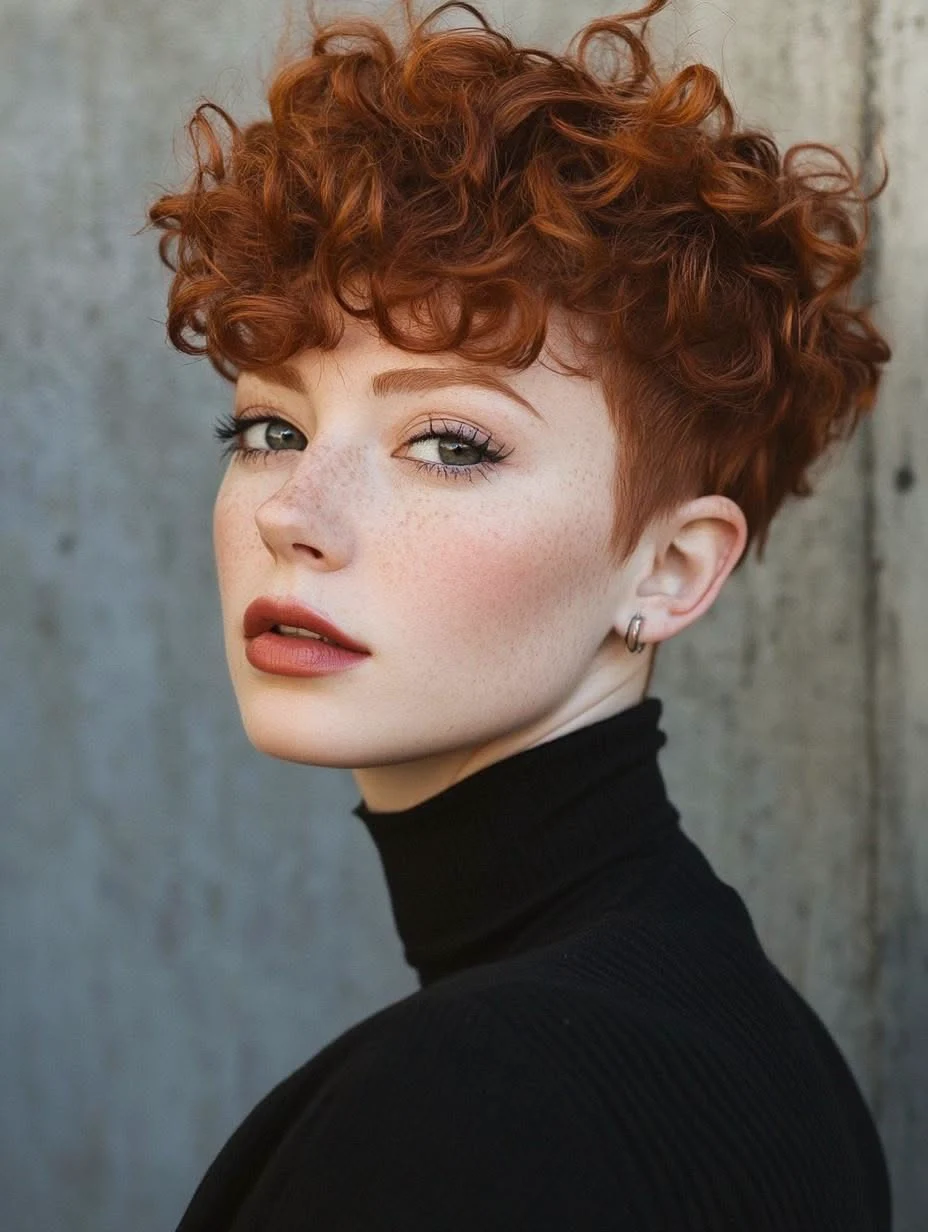
So what exactly is a short curly pixie cut? A short curly pixie cut is a close-cropped hairstyle — typically 1 to 4 inches in length — that embraces natural curl texture. It features tapered or undercut sides with more length and curl definition on top. It suits most face shapes and works across all curl patterns from 2A waves to 4C coils.
Read on, because I’m breaking down 16 stunning variations, who each one works best for, the styling products you actually need, the mistakes everyone makes, and curl-specific care tips that will keep your pixie looking sharp — not shrunk.
Why the Curly Pixie Cut Deserves More Credit
Let’s be honest. A lot of people with curly hair are terrified of going short. Shrinkage is real. Unpredictability is real. But here’s the thing: curly pixie cuts are actually easier to manage than long curly hair in many ways. Less detangling. Less product. Less time. And the curl texture that felt overwhelming at length becomes your greatest asset when cropped close.
These 16 styles prove exactly that.
16 Short Curly Pixie Cut Styles
1. The Classic Curly Pixie

Source: @Pinterest
The classic curly pixie is where most people start — and for good reason. It works.
This cut keeps the sides tapered short (around half an inch to one inch) while leaving 2–4 inches of curly length on top. The top curls spring upward and slightly forward, creating a naturally rounded crown. It’s clean, it’s confident, and it requires almost no manipulation once it’s styled. The natural curl pattern does the architectural work for you.
Who it suits: Oval and heart-shaped faces. Works on curl types 2C through 4B.
Styling tip: Apply a leave-in conditioner to damp hair, follow with a curl cream, and scrunch upward. No touching until completely dry — disturbing wet curls creates frizz.
Practical note: Tell your stylist you want a “tapered pixie with length preserved on top for curl definition.” That phrasing matters. A lot of stylists default to cutting curls shorter than needed because they forget about shrinkage.
This style is the foundation — but things get more interesting from here.
2. The Tapered Curly Pixie

Source: @Pinterest
Think of the classic pixie, then take the sides shorter — close to a fade. That’s the tapered curly pixie.
The taper here is gradual and precise, creating a clean line from the nape up. The contrast between the closely cropped sides and the curly top is dramatic in the best way. It’s modern, geometric, and surprisingly versatile — it reads as bold in casual settings and sharp in professional ones. The curl on top benefits from the shorter sides because it has room to spring upward without the weight of longer side hair pulling it down.
Who it suits: All face shapes, but especially round faces — the height on top and closeness at the sides creates a lengthening effect. Best for 3A–4C curl types where the coil structure creates visible, defined shape.
Styling tip: Use a defining gel or custard on the top section. Smooth the sides down with a light edge control product to keep the taper clean.
3. The Curly Pixie with Side-Swept Bang

Source: @Pinterest
A single swept section across the forehead changes the entire personality of a pixie cut. And when those curls are falling softly across your face? Genuinely stunning.
The side-swept bang doesn’t have to be heavy or blunt. In a curly pixie, it’s more of a trailing section of curls that’s slightly longer than the rest of the top — directed loosely across the forehead. It softens the overall look and adds a romantic, feminine quality without sacrificing the boldness of the short cut.
Who it suits: Square and rectangular face shapes benefit the most. The diagonal sweep of the bang breaks up strong angular lines. Also great for anyone transitioning from a longer style — the bang feels familiar and face-framing.
Styling tip: Apply your curl product, then direct that front section across the forehead with your fingers while hair is still wet. Once dry, it’ll hold the general direction without looking stiff.
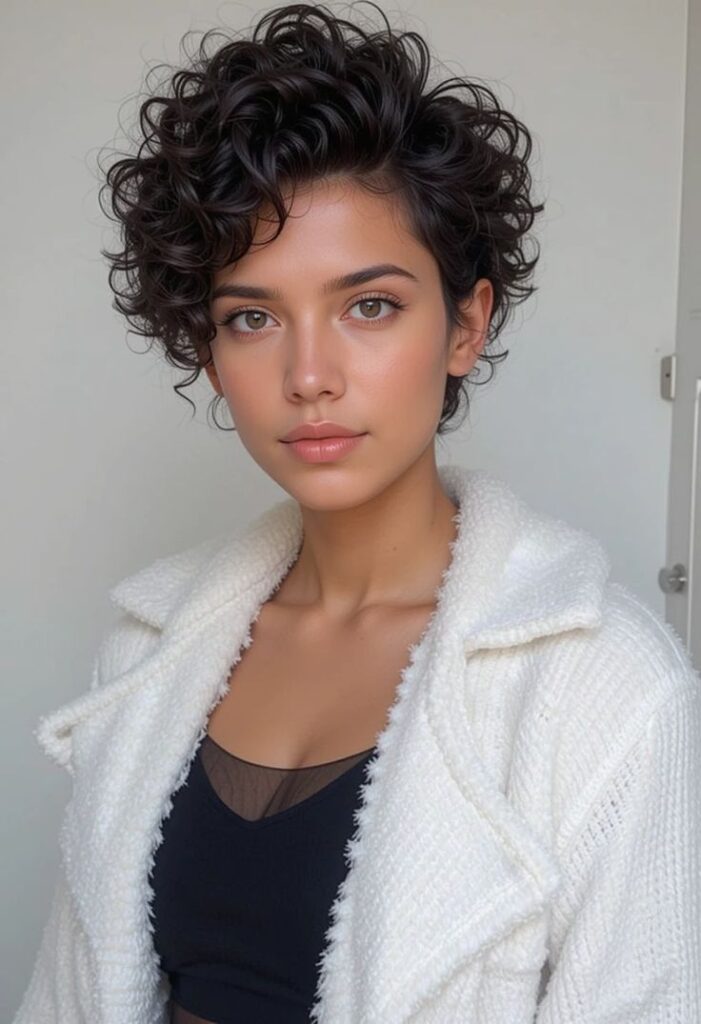
4. The Afro Pixie
Source: @Pinterest
The afro pixie celebrates volume, coil definition, and natural texture in one compact, beautiful shape.
Unlike pixies that taper close, the afro pixie allows more volume at the sides and top — shaped into a rounded silhouette that references the classic afro while remaining cropped overall. The hair is typically 3–5 inches at its longest point. The key is shaping: regular trims to maintain the round perimeter are what make this cut look intentional rather than grown-out.
Who it suits: 4A, 4B, and 4C curl types where natural coil volume creates the shape organically. Round and oval faces work especially well because the symmetrical volume creates a balanced frame.
Styling tip: Stretch damp hair very slightly with a pick or your fingers to avoid excess shrinkage before applying a holding cream. Define the perimeter with small scissors at home between salon visits.
5. The Undercut Curly Pixie

Source: @Pinterest
One of the most editorial looks on this list. The undercut removes hair beneath a defined section at the nape or sides, creating a striking contrast.
The undercut can be a full side shave, a partial nape undercut hidden under longer top layers, or a geometric pattern etched into the shaved section. Combined with the curly top, the result is avant-garde but wearable. The shaved section also gives you a summer-cool option — pull the top curls back slightly and reveal the undercut when you need ventilation.
Who it suits: Bold personalities, obviously. In terms of face shape, oval and heart-shaped faces handle the asymmetry of a side undercut best.
Styling tip: Keep the shaved section fresh with regular barber visits every 2–3 weeks. Contrast is the whole point — a grown-out undercut loses the effect entirely.
6. The Curly Pixie Bob (Pixob)

Source: @Pinterest
Not quite a pixie, not quite a bob. The pixob is the perfect in-between.
This style sits slightly longer than a traditional pixie — the back is cropped close but the front and sides inch toward jaw length, with curls filling in the shape. It’s a great transition cut for people growing a pixie out, or for people who want the ease of short hair without fully committing to a cropped nape. The curls create a natural volume that makes the “bob” shape feel full without requiring blow-out volume.
Who it suits: All face shapes. Particularly flattering on longer faces because the jaw-length sides add horizontal visual weight. Works on 2B–4A curl types.
Styling tip: Diffuse on medium-low heat, scrunching from underneath. A tiny amount of anti-frizz serum on the outer layer after drying gives a polished, defined finish.
7. The Curly Faux Hawk Pixie

Source: @Pinterest
If you want a pixie that turns heads when you walk into a room, this is it.
The faux hawk pixie channels punk energy through a strip of longer, curl-defined hair running front to back across the crown, with the sides closely cropped or faded. It doesn’t require shaving the sides — they’re just significantly shorter than the center strip. The curls on that central strip become the focal point: defined, voluminous, and dramatic.
Who it suits: Oval, oblong, and diamond face shapes. The vertical emphasis suits faces with balanced or slightly narrow proportions.
Styling tip: Apply a strong-hold curl gel to the center strip, scrunching firmly. Direct all volume upward using a diffuser from below. Finish with a light hairspray to hold the height.
8. The Defined Coil Pixie

Source: @Pinterest
This style is specifically designed for tighter curl patterns — 3C through 4C — and makes coil definition the entire aesthetic.
Rather than shaping the hair for volume or height, the defined coil pixie focuses on individual curl definition. Each coil is encouraged to spring into its natural shape through careful product layering, creating a mosaic of defined, individual spirals across the cropped length. It’s meticulous. It’s intricate. And it looks incredible.
Who it suits: 3C–4C curl types. Oval and heart face shapes.
Styling tip: The “shingling” technique works brilliantly here. Working in small sections on soaking-wet hair, rake a curl cream through each section from root to tip, smoothing the product down each individual curl. The result is maximum definition.
9. The Two-Tone Curly Pixie

Source: @Pinterest
Color transforms a curly pixie from great to unforgettable. The two-tone approach — usually darker roots transitioning to lighter ends, or a bold color contrast between the top and sides — takes full advantage of the short length to showcase color as a design element.
The most popular combinations: dark base with honey-blonde or copper ends; natural color on sides with a vivid top (burgundy, electric blue, platinum); or a subtle ombre from dark brown to warm caramel. With curly texture, even subtle color differences become more visible because the light hits each curl at a different angle.
Who it suits: Anyone willing to commit to color maintenance. Works on all face shapes and curl types.
Styling tip: Colored curls need extra moisture. Switch to a sulfate-free shampoo immediately and use a weekly toning treatment for bleached sections to prevent brassiness.
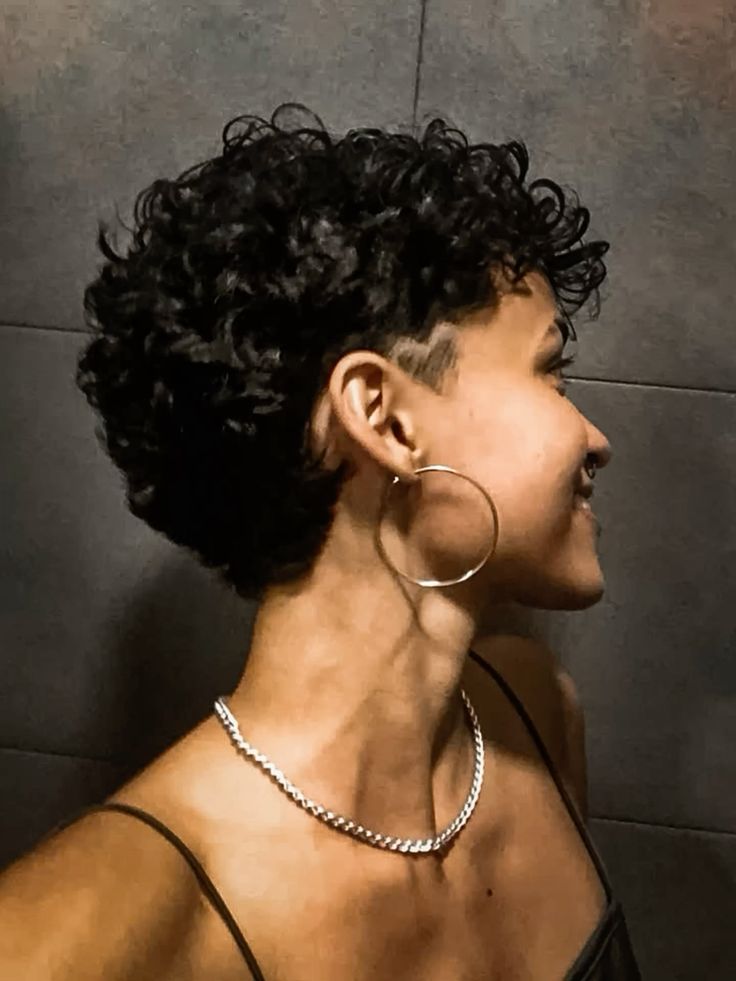
10. The Curly Pixie with Shaved Design
Source: @Pinterest
Taking the undercut one step further — a shaved geometric or freehand design etched into the closely cropped sides.
Diamonds, lines, waves, botanical patterns, abstract geometric shapes — the closely shaved sides of a pixie cut are essentially a canvas. When the curly top is left full and natural, the contrast between the artful shaved design and the organic curl texture creates a look that’s genuinely one-of-a-kind. This is the highest-maintenance style on the list but also the most personalized.
Who it suits: All face shapes, but particularly oval and diamond. Best on 3A–4C types where the curly top is full enough to contrast with the shaved sides.
Styling tip: Designs typically need refreshing every 10–14 days. Find a barber who specializes in hair art — a general barber may not have the freehand skill required.
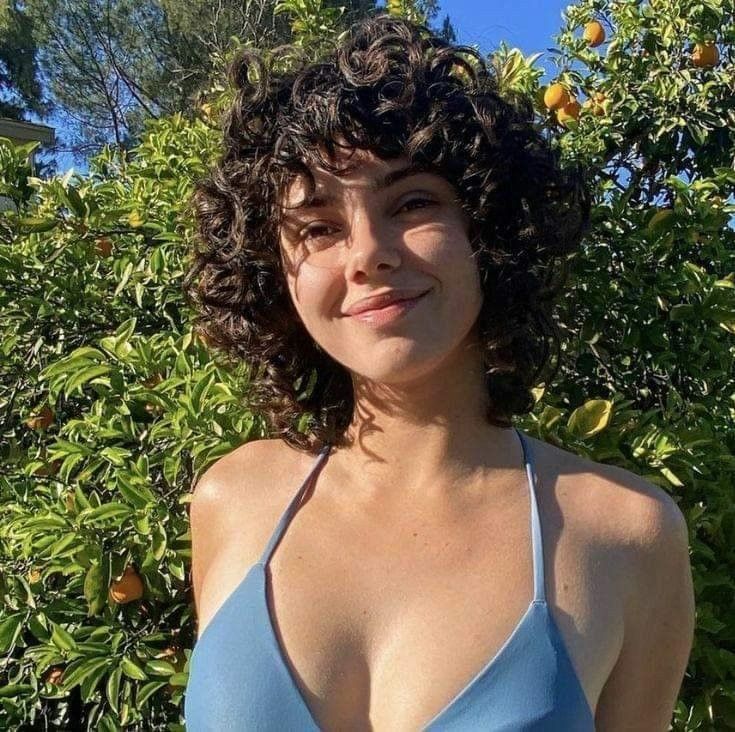
11. The Loose Wave Pixie
Source: @Pinterest
Not all curly pixies need tight coils. The loose wave pixie celebrates 2A–2C wave patterns in a short crop.
Waves at this texture sometimes get overlooked in curly hair conversations because they’re not “curly enough.” But in a pixie cut, loose waves create a soft, beachy, effortlessly cool result. The waves fall naturally around the cropped shape, adding movement and dimension without the volume of tighter curl types.
Who it suits: 2A–2C wave patterns. Oval, square, and heart face shapes.
Styling tip: Sea salt spray applied to damp hair and scrunched in gives loose waves the grip and texture they need to hold a defined shape at shorter lengths. Air dry whenever possible.
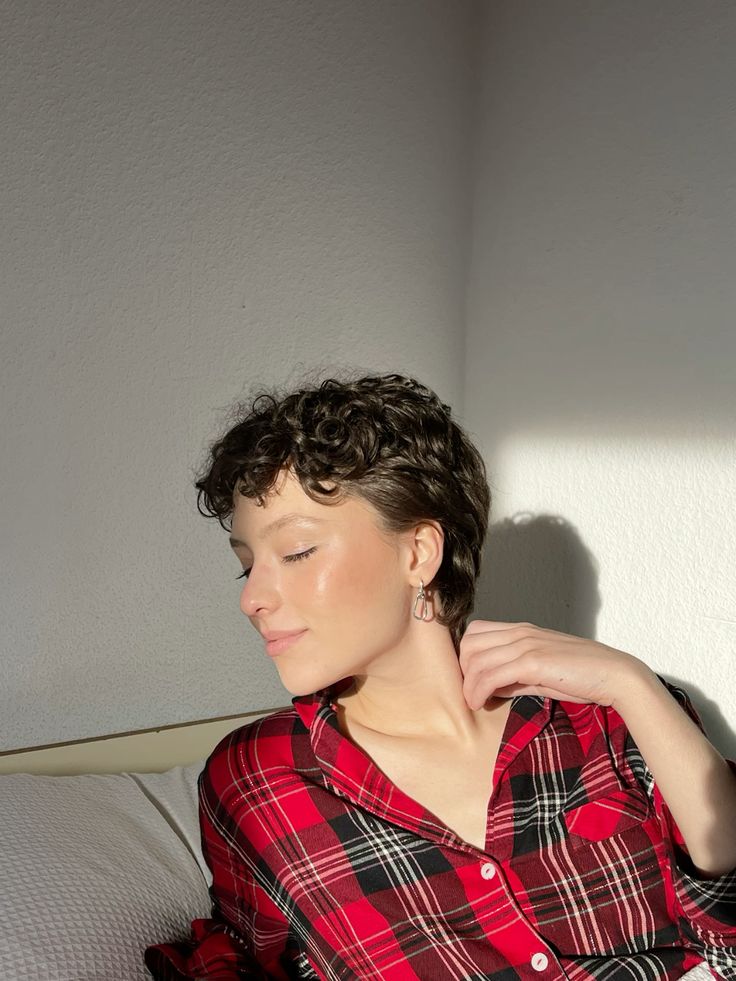
12. The Curly Nape Pixie
Source: @Pinterest
This understated style keeps most of the head close-cropped but intentionally leaves a slightly longer, curl-defined section at the nape of the neck.
It’s subtle. It’s sophisticated. And it’s the kind of detail that people notice once they look twice. The nape curls can be finger-coiled for maximum definition or left to spring naturally. When paired with small earrings, the effect is genuinely elegant.
Who it suits: All face shapes. A lovely choice for professional environments where a more dramatic pixie might feel too bold.
Styling tip: Finger-coil the nape section by twisting small sections of wet hair around your finger. This creates a uniform, polished coil without any tools.
13. The Curly Pixie with Headband

Source: @Pinterest
This isn’t really a different cut — it’s a completely different way to style the same cut.
A wide fabric headband pushed back from the hairline transforms a casual curly pixie into something that looks intentional and styled. Velvet headbands add polish. Silk scarves add drama. Even a simple thin elastic band adds visual interest. The headband also solves the “in-between stage” problem when your pixie starts growing out.
Who it suits: Anyone with a curly pixie at any stage of growth.
Styling tip: Push the headband back about an inch from your hairline. Let the front curls fall forward over the band naturally — don’t tuck them in. The contrast between the band and the free curls is the whole look.
14. The Curly Micro Pixie

Source: @Pinterest
The boldest cut on this list. The micro pixie is cropped extremely close — we’re talking half an inch to an inch across the entire head.
At this length, curl pattern determines the entire aesthetic. Looser waves will appear almost straight. Tighter coils will show as a soft, close-set texture. The micro pixie removes hair almost entirely from the styling equation and lets face shape, bone structure, and features speak for themselves. It’s the most low-maintenance style here and — on the right person — the most striking.
Who it suits: Oval, heart, and diamond face shapes. Strong features thrive without hair framing them. This cut is also ideal for people undergoing chemotherapy who want a graceful transition through hair loss, or anyone wanting to do a complete hair reset.
Styling tip: A moisturizing scalp oil applied lightly across the cropped hair keeps the scalp healthy and gives a clean, intentional finish. That’s it. That’s the whole routine.
15. The Curly Asymmetrical Pixie

Source: @Pinterest
One side longer than the other. That’s the premise — but the execution is everything.
In an asymmetrical curly pixie, one side (usually the right) is left with more curl length than the other, creating a diagonal visual line across the face. The contrast is subtle enough to look intentional, dramatic enough to look interesting. The longer side can frame one eye, drape toward the jaw, or simply create an unexpected angle in the silhouette.
Who it suits: Square face shapes especially — the off-center asymmetry disrupts the face’s symmetrical lines. Also excellent for oval faces. Not ideal for round faces, where the asymmetry can emphasize width.
Styling tip: The longer side needs slightly more product to stay defined and not fall flat against the face. Focus curl cream application on that section specifically.
16. The Natural Gray Curly Pixie

Source: @Pinterest
I saved this one for last because it might be the most beautiful — and the most underrated.
Gray curls are extraordinary. The silver, white, and salt-and-pepper tones catch light in a way that colored or dark hair simply doesn’t. A short curly pixie allows the full complexity of a natural gray color to be visible — the variation in tone, the sheen, the depth. It looks incredibly sophisticated and completely intentional.
Who it suits: Anyone embracing their natural gray. Works on all curl types and face shapes. The short length of a pixie is actually ideal for transitioning away from dye — you’re removing the colored ends without the awkward two-tone grow-out.
Styling tip: Gray hair tends to be coarser and drier than pigmented hair. Use a hydrating, bond-strengthening shampoo and conditioner. A purple toning shampoo once per week keeps silver and white tones crisp instead of yellowing.
Quick Reference Tables
16 Short Curly Pixie Cuts: At a Glance
| Style | Best Face Shape | Best Curl Type | Maintenance | Boldness Level |
|---|---|---|---|---|
| Classic Curly Pixie | Oval, Heart | 2C–4B | Low | Medium |
| Tapered Curly Pixie | All (esp. Round) | 3A–4C | Medium | Medium |
| Side-Swept Bang Pixie | Square, Rectangle | 2C–4A | Low | Medium |
| Afro Pixie | Round, Oval | 4A–4C | Medium | Medium |
| Undercut Curly Pixie | Oval, Heart | All Types | High | Very High |
| Curly Pixie Bob | All (esp. Long) | 2B–4A | Low | Low–Medium |
| Faux Hawk Pixie | Oval, Oblong, Diamond | 3A–4C | Medium | Very High |
| Defined Coil Pixie | Oval, Heart | 3C–4C | High | Medium |
| Two-Tone Curly Pixie | All | All Types | Very High | High |
| Shaved Design Pixie | Oval, Diamond | 3A–4C | Very High | Very High |
| Loose Wave Pixie | Oval, Square, Heart | 2A–2C | Low | Low |
| Curly Nape Pixie | All | All Types | Low | Low |
| Headband Pixie | All | All Types | Low | Low |
| Micro Pixie | Oval, Heart, Diamond | All Types | Very Low | High |
| Asymmetrical Pixie | Square, Oval | All Types | Medium | High |
| Natural Gray Pixie | All | All Types | Low | Medium |
Best Products by Curl Type for Pixie Cuts
| Curl Type | Texture | Best Product Category | Why It Works |
|---|---|---|---|
| 2A–2B | Fine waves | Sea salt spray, light mousse | Adds grip without weighing waves down |
| 2C–3A | Defined waves/loose curls | Curl cream, light gel | Enhances definition without crunch |
| 3B–3C | Medium-tight curls | Curl custard, defining gel | Holds curl shape at shorter lengths |
| 4A | Tight coils | Butter, heavy cream | Seals in moisture for coil definition |
| 4B–4C | Very tight coils | Shea butter, curl pudding | Maximum moisture retention |
Common Mistakes and How to Avoid Them
1. Not accounting for shrinkage This is the single biggest issue with curly pixie cuts. Curly hair can shrink 30–75% when dry compared to when it’s wet. If you don’t communicate this to your stylist, they’ll cut to the wet length — and you’ll end up with a much shorter cut than intended. Always cut curly hair in its dry, natural state, or ask your stylist to work curl by curl.
2. Choosing the wrong length for your curl type Tighter curl patterns (4B, 4C) need slightly more length than looser patterns to achieve the same visual result, because they shrink more. If you have tight coils and ask for the same length as someone with loose waves, you’ll end up with far less visible length once dry.
3. Using heavy products on fine-textured curls Heavy butters and creams are meant for dense, coarse curl textures. On fine wavy or curly hair, they cause limpness and buildup. Match your product to your actual texture, not just your curl pattern.
4. Skipping the diffuser Letting a curly pixie air dry flat against the head can result in a shapeless, flat result. A diffuser lifts the roots and encourages each curl to spring into its natural shape. It’s not optional for most curl types at this length.
5. Washing too often Curls need natural scalp oils to stay moisturized and defined. Washing daily — especially with sulfate shampoos — strips those oils and leads to frizz. Aim for 1–2 washes per week, co-washing (conditioner only) in between.
6. Not refreshing curls between washes Short curls can get flattened overnight. A simple refresh — spray bottle with water plus a tiny bit of leave-in conditioner, scrunched into the hair — revives curl shape without a full wash.
Similar Variations Worth Knowing
- The Buzz Cut with Curl Texture — Even shorter than a micro pixie; essentially all one length, showcasing texture rather than shape.
- The TWA (Teeny Weeny Afro) — Common transition cut when going natural; similar to the afro pixie but typically closer cropped.
- The Short Shag — A little longer than a pixie, adding more layered texture and a slightly different silhouette.
- The Curly Bob — When a pixie grows out to jaw length; all the curl definition, more overall length.
- The Curtain Bang Pixie — A longer center fringe parted in the middle and swept to both sides, incorporated into a short cut.
Hair Care Tips for Short Curly Pixie Cuts
Short curly hair still needs real care. Here’s what I’ve found actually works.
Moisture first, always. Even at short lengths, curly hair is prone to dryness because the natural oils from your scalp have a shorter hair shaft to travel down. A leave-in conditioner applied to damp hair after every wash (or refresh) is non-negotiable.
Invest in a silk or satin pillowcase. Cotton pillowcases absorb moisture from your curls overnight and cause friction that leads to frizz and breakage. A silk or satin pillowcase — or a silk bonnet — makes a visible difference by morning.
Use the “LOC” or “LCO” method. This layering technique (Liquid, Oil, Cream — or Liquid, Cream, Oil) locks moisture into each curl at the strand level. Apply in damp hair and scrunch each layer in before the previous one fully dries.
Trim every 6–8 weeks. Short cuts lose their shape quickly. Regular trims — even tiny ones — keep the perimeter defined, the layers intact, and the shrinkage predictable.
Protect from heat diligently. If you use a diffuser regularly (and you probably should), apply a heat protectant spray to damp hair before diffusing. Short hair is closer to the scalp, meaning heat damage has nowhere to hide.
Clarify monthly. Product buildup is a real issue with curly hair because we use more products than straight-haired folks. A clarifying shampoo once a month removes buildup that regular shampoo leaves behind — and your curls will spring back to life immediately after.
Don’t neglect your scalp. A healthy scalp is the foundation of healthy curls. Massage your scalp with your fingertips (not nails) for 2–3 minutes each wash day to stimulate circulation and distribute natural oils.
Outro
Short curly pixie cuts are more than just a hairstyle. They’re a statement about embracing what your hair naturally does — its texture, its volume, its personality — rather than fighting it. From the ultra-cropped micro pixie to the full, shaped afro pixie, there’s a version of this cut that works for every curl type, every face shape, and every comfort level with boldness.
The key is knowing your curl type, communicating with your stylist about shrinkage, choosing the right products for your texture, and committing to a simple but consistent care routine. Do those things, and your short curly pixie cut will be one of the best decisions you’ve ever made for your hair.