
17 Hairstyles With Edges: Laid, Sleek & Perfectly Defined Looks for Every Occasion
You know that feeling when someone’s edges are so perfectly laid you have to do a double-take? Like — how? That’s the reaction I want every person reading this guide to get when they walk out the door. Hairstyles with edges are more than a trend — they’re a craft, a form of self-expression, and for many people, a deeply personal part of their cultural identity. I’ve put together the most complete, practical guide to edge-laying hairstyles you’ll find anywhere, and I’m not holding anything back.
So what are hairstyles with edges? Hairstyles with edges are styles where the baby hairs along the hairline — temples, nape, and forehead — are deliberately smoothed, shaped, or sculpted using edge control products, a soft brush, and sometimes a scarf or wrap. Common styles include sleek buns, braided updos, ponytails, and natural sets, all finished with defined, laid edges in swirled, waved, or straight patterns.
Stick around because I’ll show you all 17 styles in detail, explain which edge products actually work, walk you through the exact tools you need, and cover the mistakes that are secretly damaging your hairline — without you even realizing it.
What “Laying Edges” Actually Means (And Why It Matters)
Let’s be clear about something before we dive in. Edges — also called baby hairs — are the fine, shorter hairs that grow along the perimeter of the hairline. They’re typically more delicate and fine than the rest of the hair, which is exactly why they require their own specific care and technique.
Laying edges is the practice of smoothing, shaping, and sometimes sculpting those perimeter hairs into deliberate patterns using edge control gel, a boar bristle or soft toothbrush, and a satin scarf to set the style. It’s a technique deeply rooted in Black hair culture and has been practiced for decades, appearing prominently in styles across the 1990s through today.
Done right, laid edges completely transform a hairstyle — adding polish, intentionality, and a finished quality that no amount of volumizing or styling in the rest of the hair can replicate. Done wrong, they can cause hairline thinning and breakage. That’s why getting the technique and the products right matters so much. Now let’s get into the styles.
1. High Bun With Edges

Source: @Pinterest
The high bun with edges is the gold standard of laid edges hairstyles — elegant, polished, and unmistakably intentional.
Pull all hair into a high ponytail and wrap it into a smooth bun, secured with an elastic and bobby pins. The magic happens at the hairline: apply a moderate amount of edge control along the temples and forehead, then use a soft-bristle edge brush to sculpt the baby hairs into small swirl or wave patterns. Cover with a satin scarf for 10–15 minutes to set the edges before removing and misting lightly with a shine spray.
The swirl pattern is the most classic and recognizable edge design. Start each swirl from the base of the edges and use a circular motion with the brush, pinning each swirl in place while the product dries for a crisp, defined result.
- Best for: All natural textures, medium to long hair
- Time: 15–20 minutes total
- Edge style: Classic swirls at temples and forehead
- Key products: Strong-hold edge control, boar bristle brush, satin scarf
2. Low Bun With Edges

Source: @Instagram
If the high bun is the queen, the low bun with edges is the sophisticated older sister — a little more understated but just as striking.
Gather hair into a smooth low bun at the nape of the neck. Use a boar bristle brush and a firm-hold pomade or edge control to lay the hair completely flat against the scalp before securing. At the hairline, use a fine-tooth edge brush or a soft toothbrush to create small S-shaped waves or C-curves along the temples. Set with a satin scarf, then carefully remove and finish with a light-hold finishing spray.
The low bun keeps weight at the nape — which is much gentler on the hairline than a high bun if you wear it regularly. Alternate between low and high buns to distribute tension across the scalp.
- Best for: All textures, medium to long hair
- Time: 12–18 minutes
- Edge style: S-waves or C-curves at temples
- Key products: Firm-hold pomade, fine-tooth edge brush, finishing spray
3. Box Braids with Edges

Source: @Pinterest
Box braids with edges are one of the most powerful hair combinations in existence — protective style meets precision grooming.
Once box braids are installed, the hairline becomes the canvas. Use a lightweight edge control (heavy products can cause buildup around braid bases) and an edge brush to smooth and define baby hairs in swirls, wings, or waves. Because box braids can last 4–8 weeks, maintaining the edges throughout the wear is important — touch them up every 4–5 days using a light gel and a soft brush.
Avoid using silicone-heavy edge controls around braid bases as they can cause slippage and buildup that’s difficult to remove without disturbing the braids.
- Best for: Box braids of all sizes, natural hair
- Time: 5–10 minutes for edge touchup
- Edge style: Swoops, swirls, or flat waves at the hairline
- Key products: Lightweight edge control, soft toothbrush, non-silicone formula
4. Edges With Knotless Braids

Source: @Instagram
Knotless braids are gentler on the hairline than traditional box braids — and paired with edges styling, the result is absolutely stunning.
The feathered baby/edges hair look involves letting the shortest, finest hairs at the very front of the hairline remain loose and slightly wispy rather than laying them flat. Apply a very light-hold edge control or even just a small amount of edge oil, then use a soft brush to gently separate and define the finest hairs into individual strands. This creates a soft, halo-like frame around the face.
The edge style works particularly beautifully when knotless braids begin slightly behind the natural hairline, leaving those fine baby hairs completely free to frame the face naturally.
- Best for: Fine baby hairs, knotless or feed-in braids
- Time: 5–8 minutes
- Edge style: Feathered, wispy individual strands
- Key products: Light-hold edge oil or water-based gel, ultra-soft brush
5. Sleek Ponytail With Edges

Source: @Pinterest
The edge is the most dramatic and eye-catching edge style on this list — and the sleek ponytail is its perfect partner.
Pull hair into a tight high or mid-level ponytail. At the hairline, create a single dramatic swoop — a long, curved sweep of baby hair that arcs from one temple across the forehead and down to the other side. This requires more edge control than a standard swirl and benefits from using a firm-hold gel-and-cream hybrid. Set the swoop with a satin scarf for at least 15 minutes before removing. Mist with a light-hold spray and let it fully dry before touching.
The single swoop looks most striking when it’s clean, smooth, and perfectly symmetrical. Use a thin comb handle or a rat-tail comb to shape the curve before the product sets.
- Best for: All textures, medium to long hair
- Time: 15–20 minutes
- Edge style: Single dramatic swoop across the forehead
- Key products: Firm-hold edge control, rat-tail comb, satin scarf
6. Space Buns with Edges

Source: @Pinterest
Two buns, two swoops — this look doubles down on personality and makes a statement from across the room.
Create two high buns on either side of the head. At the hairline on each side, sculpt a matching swoop that curves away from the center, one on each temple. The symmetry of double swoops with space buns creates a playful but polished look that works beautifully for festivals, photoshoots, and special events.
Use a stencil or ruler to ensure both swoops have matching curves — this is the detail that separates a good double swoop from a great one.
- Best for: All natural textures, medium to long hair
- Time: 20–25 minutes
- Edge style: Symmetrical double swoops at each temple
- Key products: Strong-hold edge control, edge brush, bobby pins, satin scarf
7. Slick Back Bun With Edges
Source: @Pinterest
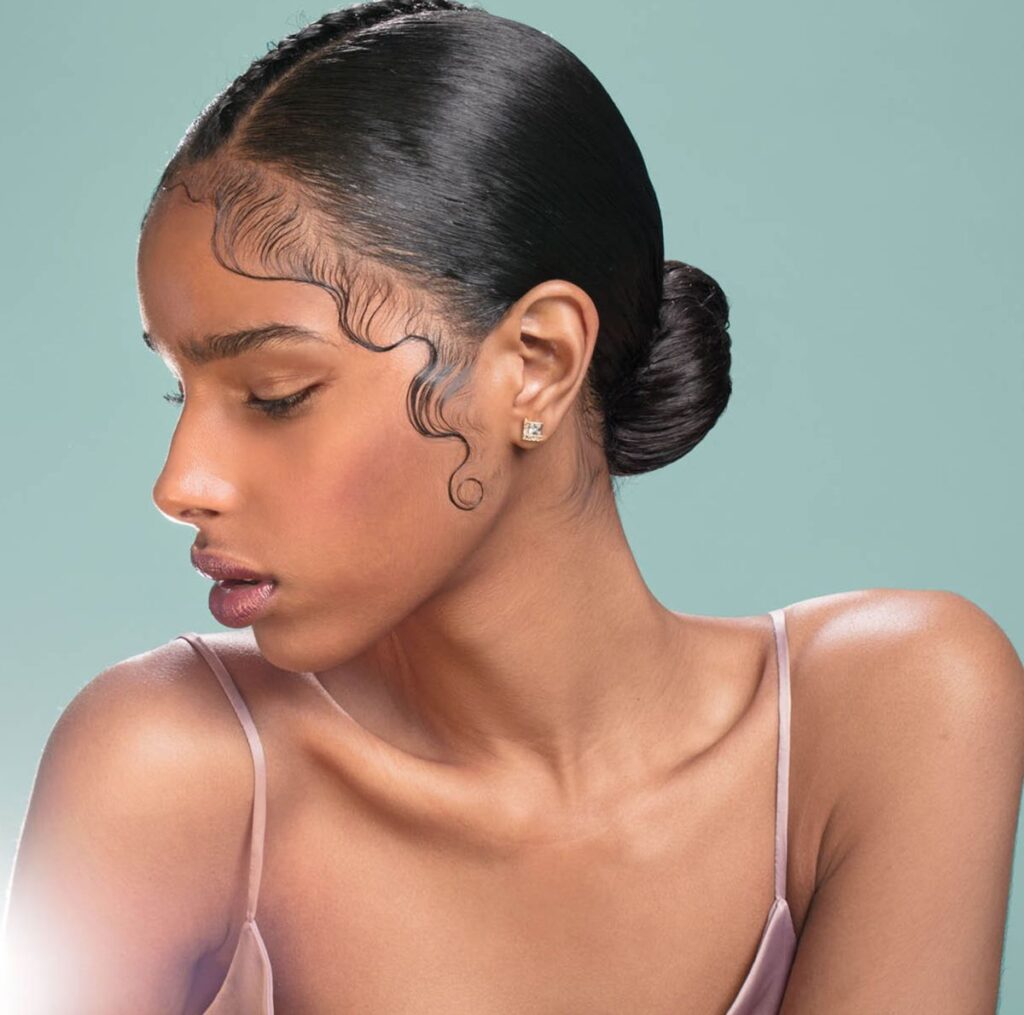
The sleek back bun is a celebration of natural volume and texture — and when you add defined edge art, it becomes a masterpiece.
Slick Back Bun With Edges
Sweep all the hair straight back using a boar bristle brush and a generous amount of gel, smoothing every strand flat against the scalp until the surface is completely sleek and tension-free. Gather everything into a tight, clean bun sitting high at the crown, then secure it firmly. Now the real work begins — at the hairline, apply edge control with a small brush to sculpt deliberate, precise patterns along the forehead and temples.
The slicked-back bun is essentially the perfect canvas. The smoother and more polished the hair behind it, the sharper and more striking the edges appear against it.
- Best for: Type 3–4 natural hair, medium to long lengths
- Time: 10–15 minutes
- Edge style: Artistic — swirls, waves, or custom geometric patterns
- Key products: Strong-hold edge gel, detail brush, satin scarf, stong hold elastic
8. Cornrows with Edges
Source: @Pinterest
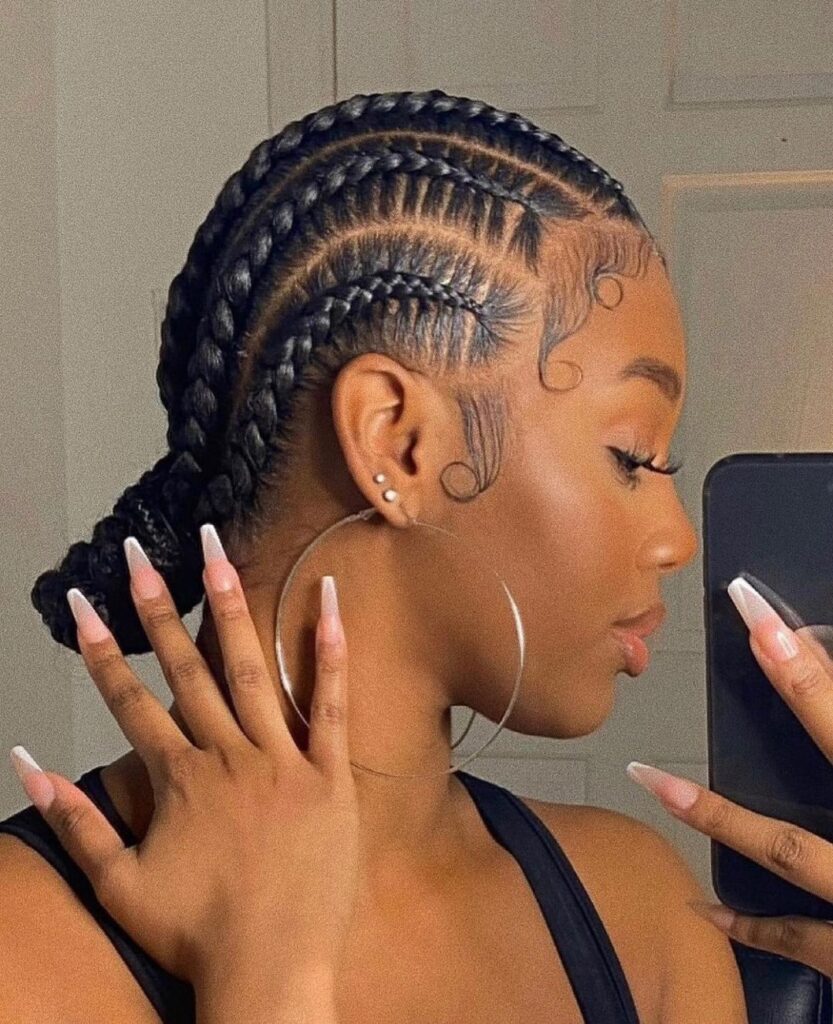
Cornrows are a timeless protective style, and edges at the hairline complete the look with a level of precision that turns heads.
Cornrows with edges are the defining detail that separates a polished protective style from an unfinished one. Once the braids are laid, the hairline becomes the focal point — and how those edges are sculpted determines the entire impression of the look. Apply a firm-hold edge control using a thin-bristle brush, working temple to forehead in deliberate, consistent strokes. Swirl or wave each section to echo the direction of the cornrows, creating visual harmony between the braids and the hairline.
For cornrows that begin directly at the hairline, work with precision — one misplaced stroke disrupts the entire braid base. Always seal edges with a light-hold gel for longevity.
- Best for: All natural textures, any length
- Time: 8–12 minutes for edge work after cornrows are done
- Edge style: Swirls or waves mirroring cornrow direction
- Key products: Firm-hold edge control, thin-bristle edge brush
9. High Puff With Edges

Source: @Pinterest
High puff doesn’t mean edges take a back seat — a puff with bold, defined edges might actually be the most impactful edge look of all.
A high puff without edges is simply a ponytail — but a high puff with meticulously laid edges is a complete, intentional style statement. The elevated volume of the puff draws every eye directly down to the hairline, making those edges the most visible and impactful detail of the entire look. Apply a firm-hold edge control with a thin-bristle brush, sculpting deliberate swirls and waves that frame the face symmetrically from temple to temple.
The contrast between the full, voluminous puff above and the sleek, defined edges below creates a striking structural balance. Always finish with a light-mist spray to lock every stroke in place.
- Best for: very short natural hair, type 3–4 textures
- Time: 10–15 minutes
- Edge style: Bold swirls or geometric shapes
- Key products: Maximum-hold edge control, boar bristle or detail brush
10. Dramatic Edges With Braids

Source: @Instagram
Dramatic edges with braids are the ultimate power move — where precision meets artistry directly at the hairline. Once braids are fully installed, the hairline becomes the canvas. Using a strong-hold edge control and a firm-bristle brush, sculpt bold, exaggerated swirls, deep waves, or sharp geometric patterns that command immediate attention. Unlike soft or subtle edges, dramatic edges are deliberately oversized, deeply defined, and intentionally theatrical — designed to be seen.
This technique works most powerfully with sleek box braids or knotless braids, where the clean braid lines amplify the sharpness of the edges below. Dramatic edges transform braids from a protective style into a complete artistic statement.
- Best for: Senegalese or rope twists on natural hair
- Time: 5–8 minutes
- Edge style: Soft swoops or flat smooth waves
- Key products: Lightweight edge control, soft brush
11. Edges With Locs

Source: @Pinterest
Locs are a commitment to natural texture — and adding intentional edge art at the hairline shows that precision and naturalism aren’t opposites.
Whether your locs are freeform or cultivated, the baby hairs at the perimeter of the hairline remain and can be styled with edge control. Use a medium-hold gel specifically formulated for natural hair (avoid silicone-heavy formulas that can cause buildup on locs) and create swirls or waves at the temples and forehead.
On starter locs or shorter locs, edge work is particularly important because it’s one of the few areas where you can add deliberate styling. On longer locs, a clean hairline instantly elevates a simple pull-back or updo.
- Best for: All loc textures and lengths
- Time: 8–12 minutes
- Edge style: Swirls, swoops, or flat waves
- Key products: Medium-hold natural-hair gel, soft detail brush, satin scarf
12. Fluffy Edges With Braids

Source: @Pinterest
Fluffy edges with braids are the softer, more effortless alternative to the sharp, sculpted edge look — and the contrast they create against structured braids is unexpectedly stunning. Rather than laying edges completely flat, apply a light-hold cream or edge control and brush the baby hair outward in soft, loose strokes, allowing the natural texture to remain visible and airy. This deliberate softness at the hairline beautifully echoes the fullness of the braids above.
This technique works particularly well with box braids and knotless braids, where the looser braid tension already creates a naturally relaxed finish. Fluffy edges complete that effortless, undone aesthetic — intentional softness, never accidental.
- Best for: Type 3–4 natural hair, medium to long lengths
- Time: 5–8 minutes for edges (after braid-out is released)
- Edge style: Clean flat edges to contrast with braid-out texture
- Key products: Medium-hold edge control, boar bristle brush
13. Puff With Edges Natural Hair

Source: @Pinterest
This is the style for the creative, and the ones who want their hair to function as wearable art.
A puff with edges on natural hair is the ultimate celebration of texture meeting precision — voluminous, unapologetic curl definition above, paired with immaculately sculpted baby hair below. Gather the hair into a full puff at the crown using a soft-bristle brush to preserve curl integrity, then shift complete focus to the hairline. Apply a strong-hold edge control with a thin-bristle brush, sculpting deliberate swirls, waves, or curves that symmetrically frame the face from temple to temple.
The dramatic contrast between the free, untamed volume of the puff and the crisp, controlled edges below creates a look that is effortlessly powerful — structured softness at its finest.
- Best for: 3C, 4A, 4B, and 4C natural hair textures
- Time: 20–30 minutes (depends on complexity)
- Edge style: Geometric lines, angles, or custom art
- Key products: Maximum-hold edge control, rat-tail comb, detail brush, satin scarf
14. Slick Back with Edges

Source: @Instagram
Sometimes the most impressive edge work isn’t a decorative swirl — it’s a perfectly clean, smooth perimeter all the way around the head.
This style involves slicking all the hair back (into a bun, ponytail, or simply flat against the head) and then laying the entire hairline perimeter — forehead, temples, and nape — completely flat and smooth. No decorative elements. Just a sharp, pristine edge from every angle.
This edge work is particularly popular in professional and formal settings because it gives the hairline a clean, defined look without being overly decorative. It’s also the foundational skill that all other edge techniques build upon — if you master the full perimeter, everything else becomes easier.
- Best for: All textures, any updo or slicked-back style
- Time: 10–15 minutes
- Edge style: Clean, smooth full perimeter
- Key products: Strong-hold edge control, boar bristle brush, satin scarf, finishing spray
15. Natural Wash-and-Go with Softly Defined Edges

Source: @Instagram
Not every edge look needs to be dramatic — and a softly defined edge on a wash-and-go proves that subtle can be just as beautiful.
After your wash-and-go is fully dry, apply a very small amount of light-hold edge gel or water-based edge cream to the hairline. Use a soft brush to gently smooth the baby hairs — don’t try to sculpt elaborate swirls, just lay them softly in the natural direction they grow. The result is a clean, natural-looking hairline that frames the curl pattern without looking overdone.
This is the everyday approach to edges — perfect for those who want their hairline to look neat and intentional without committing to 20 minutes of sculpting before work.
- Best for: Type 3–4 curl patterns, wash-and-go styles
- Time: 3–5 minutes
- Edge style: Soft, natural-direction baby hairs
- Key products: Light-hold water-based edge cream, ultra-soft brush
16. Half-Up Half-Down with Edges

Source: @Pinterest
The half-up half-down gives you the best of both worlds — and a edge frames the face in a way that pure updos can’t.
Pull the top half of the hair up into a bun or puff. At the hairline, create a single sweeping curve that starts at one temple, arcs across the forehead, and ends at the opposite temple. This swoop follows the natural hairline curve and uses the forehead as a stage for the baby hair. The bottom half of the hair, left loose or in defined curls, creates a beautiful contrast with the clean edge above.
This style works well for all textures and is particularly stunning on natural curls and coils where the loose bottom section adds volume and dimension.
- Best for: All textures, medium to long hair
- Time: 15–20 minutes
- Edge style: Single arching swoop across the forehead
- Key products: Firm-hold edge control, rat-tail comb, satin scarf
17. Edge Protective Hairstyles

Source: @Pinterest
This is the full showstopper — a protective updo finished with a multi-layered edge design that layers swirls, swoops, and waves in a single composition.
Start with any protective updo: twisted updo, braided bun, or loc updo. Then treat the hairline as a full design canvas. Begin with a swoop at the forehead, layer swirls at each temple, add a flat wave at the sideburns, and finish with a clean, flat line at the nape. Each section uses the same product but a different technique, creating a multi-textured edge composition that looks like it was done in a high-end salon.
This is the most advanced edge style on this list and the one that gets the most compliments — and that’s all 17 hairstyles with edges covered.
- Best for: All textures, any protective updo
- Time: 25–35 minutes
- Edge style: Multi-layered combination design
- Key products: Maximum-hold edge control, multiple brush sizes, rat-tail comb, satin scarf, finishing spray
Full Comparison Table: All 17 Hairstyles With Edges
| # | Hairstyle | Edge Style | Skill Level | Time for Edges | Best Hair Type | Hold Strength Needed |
|---|---|---|---|---|---|---|
| 1 | High Bun With Edges | Classic swirls | Beginner | 10–15 min | All natural textures | Strong |
| 2 | Low Bun With Edges | S-waves / C-curves | Beginner | 10–12 min | All textures | Firm |
| 3 | Box Braids with Edges | Swoops / swirls | Beginner | 5–10 min | Natural hair | Light–Medium |
| 4 | Edges With Knotless Braids | Feathered / wispy | Beginner | 5–8 min | Fine baby hairs | Light |
| 5 | Sleek Ponytail With Edges | Single dramatic swoop | Intermediate | 15–20 min | All textures | Firm–Strong |
| 6 | Space Buns with Edges | Double symmetrical swoops | Intermediate | 20–25 min | All textures | Strong |
| 7 | Slick Back Bun With Edges | Artistic swirls or geometric | Intermediate | 10–15 min | Type 3–4 | Strong |
| 8 | Cornrows with Edges | Swirls mirroring cornrow direction | Intermediate | 8–12 min | All natural textures | Firm |
| 9 | High Puff With Edges | Bold swirls / geometric | Intermediate | 10–15 min | Type 3–4 | Maximum |
| 10 | Dramatic Edges with braids | Soft swoops / flat waves | Beginner | 5–8 min | Natural hair | Light–Medium |
| 11 | Edges With Locs | Swirls / swoops | Beginner | 8–12 min | All loc types | Medium |
| 12 | Fluffy Edges With Braids | Clean flat contrast edge | Beginner | 5–8 min | Type 3–4 | Medium |
| 13 | Puff With Edges Natural Hair | Geometric lines / custom art | Advanced | 20–30 min | Type 3–4 | Maximum |
| 14 | Slick Back with Edges | Clean full perimeter | Intermediate | 10–15 min | All textures | Strong |
| 15 | Natural Wash-and-Go with Softly Defined Edges | Soft natural-direction edges | Beginner | 3–5 min | Type 3–4 | Light |
| 16 | Half Up Half Down with Edges | Single arching swoop | Intermediate | 15–20 min | All textures | Firm |
| 17 | Edge Protective Hairstyles | Multi-layered combination | Advanced | 25–35 min | All textures | Maximum |
Edge Control Product Comparison Guide
| Product Type | Hold Level | Best Used For | Formula Notes | Avoid If… |
|---|---|---|---|---|
| Water-based edge gel | Light–Medium | Wash-and-go, protective styles | Hydrating, no buildup | You need hold to last all day |
| Cream-gel hybrid | Medium–Firm | Everyday updos, low buns | Moisturizing + control | You have very fine baby hairs (too heavy) |
| Strong-hold pomade | Firm–Strong | Sleek styles, high buns | Long-lasting, may be harder to wash out | You wear your style for multiple days |
| Maximum-hold edge control | Strong–Maximum | Swoops, geometric art, all-day hold | Typically contains stronger polymers | You have a sensitive or dry scalp |
| Edge control oil | Very Light | Feathered baby hairs, locs | Adds shine without stiff hold | You need defined, sculpted shapes |
| Gel + scarf method | Variable | Any sculpted edge style | Product + heat from scarf sets the style | You’re in a hurry |
Common Mistakes and How to Avoid Them
I see these mistakes constantly — online, in tutorials, in the mirror. Here’s what actually goes wrong and how to fix it:
Using too much product. More edge control does not equal better edges. A pea-sized amount is enough for the full hairline. Too much product creates white residue flaking, a crunchy texture that cracks throughout the day, and buildup that suffocates the hairline follicles over time.
Skipping the satin scarf step. This is the single most skipped step and the one that makes the biggest difference. The scarf presses the product into the hair shaft while it dries, creating a smooth, set shape. Without it, even a great edge control job will partially lift and lose definition within a couple of hours.
Using a stiff bristle brush. A toothbrush with hard bristles or a cheap styling brush with rough plastic bristles can scratch the scalp and break delicate baby hairs. Always use a soft boar bristle edge brush or an ultra-soft detailing brush specifically made for edges.
Pulling edges too tight into the style. Repeatedly pulling the baby hair tightly into braids, cornrows, or slicked-back styles causes traction alopecia — gradual, permanent hairline thinning. This is a medical condition and one of the most common causes of hairline recession in women who regularly wear tight styles. Keep tension minimal at the hairline and vary your hairstyles regularly.
Using the wrong product for your hair type. A maximum-hold pomade on fine baby hairs will flatten and snap them. A light water-based gel on thick, coily edges won’t provide enough hold to keep them in place. Match the product weight and hold strength to the texture and thickness of your baby hairs specifically.
Not cleaning the hairline between style changes. Product buildup at the hairline leads to clogged follicles, scalp irritation, and weakened hair growth. Every time you transition between styles, cleanse the hairline thoroughly with a gentle shampoo or a clarifying rinse before re-applying edge product.
Similar Variations Worth Exploring
- Men’s edge lineup: For men, “edges” often refers to the sharp, clean line created by a barber’s clipper at the hairline. This is distinct from baby hair styling but equally important for a polished look — a fresh lineup transforms any hairstyle.
- Edge design for children: Children’s edges can be gently styled using very light-hold, kid-friendly edge products — always avoid strong-hold formulas on children’s delicate hairlines and never pull tightly.
- Colored edge art: Some stylists use temporary hair color or colored edge gels to create vivid, artistic hairline designs for special events and photoshoots.
- Edges with wigs and weaves: Even under wigs and weave installs, the natural baby hairs along the hairline can be pulled out and laid for a more natural-looking install. This is a technique commonly used to make lace front wigs look completely seamless.
Hair Care Tips for Hairstyles With Edges
The baby hairs at your hairline are the most delicate hairs on your head. They need extra care and attention — especially if you lay them regularly.
Give your edges recovery days. Don’t lay your edges every single day. On off days, let your baby hairs air-dry naturally without any product. This prevents follicle stress and allows the hair to grow without constant tension and chemical load.
Moisturize the hairline daily. Apply a tiny amount of lightweight hair oil — jojoba, castor, or argan — to the hairline every night. Castor oil in particular has a long tradition of use for promoting edge growth and strengthening fine baby hairs. Massage it in gently with your fingertips to stimulate circulation.
Sleep in a satin bonnet or on a satin pillowcase. Cotton pillowcases create friction that roughs up and snaps fine baby hairs overnight. A satin bonnet or pillowcase eliminates that friction entirely, preserving both the hair and any edge style you’ve created.
Avoid tight hairstyles at the hairline daily. Rotating between tight styles and looser options gives the hairline periodic recovery. For days when your hair is tightly pulled back, apply a small amount of scalp oil at the hairline to minimize stress on the follicles.
Wash your hairline gently. When shampooing, avoid scrubbing aggressively at the hairline. Use your fingertips in gentle circular motions and let the lather rinse through naturally rather than working a washcloth or rough towel across the perimeter.
Address thinning early. If you notice your edges getting shorter, sparser, or patchier over time, stop all tight styling immediately and consult a dermatologist or trichologist. Early traction alopecia is often reversible with the right intervention — but the sooner you address it, the better.
Outro
Laid edges are an art form. They take practice, the right tools, and a genuine understanding of your baby hair’s texture and needs. But once you nail it, the transformation a polished, defined hairline brings to any style is nothing short of incredible.
Whether you’re going for a simple everyday smooth or an elaborate geometric swoop that stops traffic, these hairstyles with edges give you everything you need to show up looking intentional, polished, and completely yourself — from hairline to ends.